
Most community builders are solving the wrong problem.
They ask: How do I get members more active? How do I get more replies? How do I push event sign up rates up?
These questions feel reasonable because they’re visible. Your boss asks about them. Your dashboard displays them. Your peers compare against them. So you pour everything into designing better topics, more interesting events, cleverer icebreakers believing that if engagement goes up, everything else will follow.
But here’s a truth that gets repeatedly validated and rarely acknowledged: an active community and one with sustainable community engagement are often not the same thing.
Events are happening. Conversations are flowing. Members are showing up. Then you take two weeks off and come back to a silence so complete it’s as if nothing ever existed. You start rebuilding, reactivating, re-proving your worth. The cycle repeats—until you realize the root cause isn’t “not enough engagement” but something far more hidden.
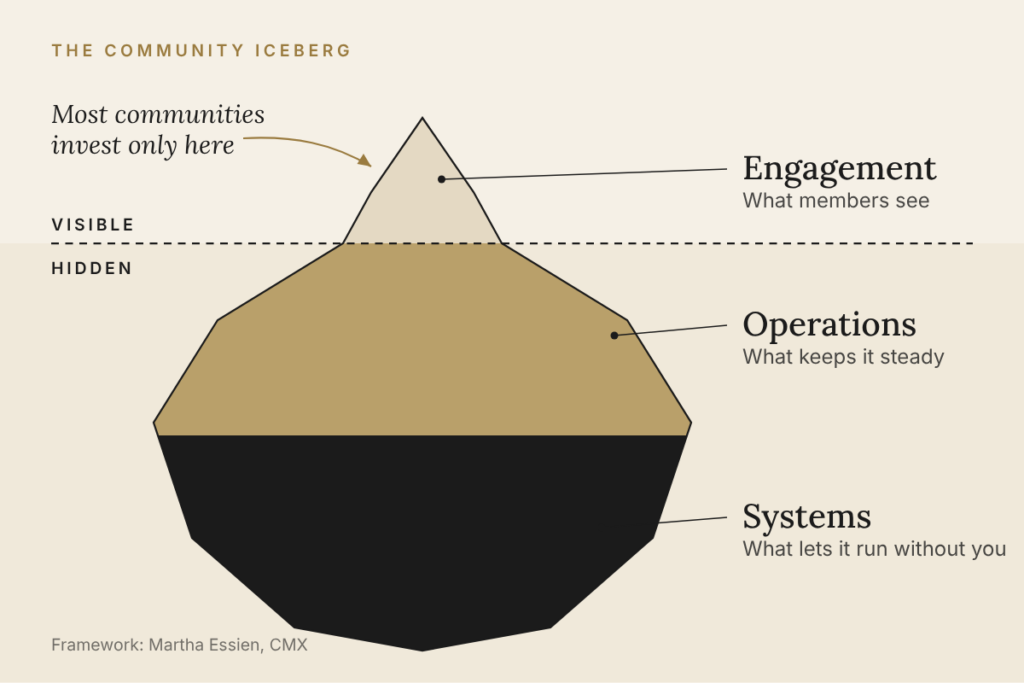
CMX researcher Martha Essien proposed a three-layer framework that remains the clearest breakdown of this problem available:
Layer one is engagement—the things members experience. Events, discussions, content, a sense of connection. This is what you stare at every day, and what virtually every community strategy defaults to focusing on.
Layer two is operations—the things that make the experience consistent. Workflows, coordination mechanisms, who’s responsible for what and when. Members don’t notice this layer exists—unless it breaks. A healthy operations layer means that whether you’re energized or overwhelmed today, the experience members receive is stable.
Layer three is systems—the things that make everything sustainable. Documentation, templates, SOPs, knowledge bases, dashboards. Almost nobody praises this layer, but it determines whether your community keeps running or collapses the moment you leave for two weeks, quit, or your team turns over.
Most communities only invest in layer one. The result: sustainable community engagement never materializes. The community depends on the community manager’s presence and willpower. You’re gone, cracks appear.
This isn’t a personal capability problem. It’s a structural one.
The community management industry has a beautified disease: treating constant availability as a badge of devotion.
In discussions about community manager burnout, one pattern keeps recurring: managers answering messages at night, on weekends, on holidays. Resolving every issue instantly. Anticipating the next problem before it happens. But when things go well, the board and members take the credit; when things go wrong, the spotlight snaps to the manager.
The more insidious damage is that this “always-on” expectation shapes community behavior in reverse. When you reply within seconds every time, members learn they don’t need to wait. When you personally intervene every time, members learn they don’t need to solve things themselves. The harder you work, the deeper the community’s dependence on you—and the further away sustainable community engagement becomes.
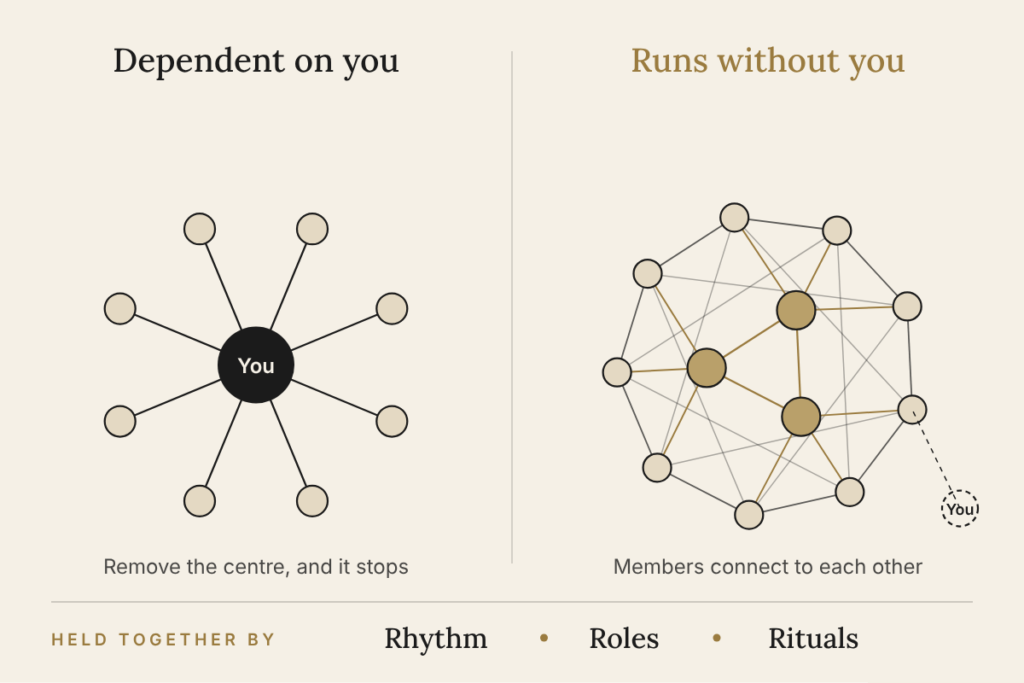
One practitioner’s comment nails it: “If your community collapses when you log off, you don’t have structure. You have dependency.”
Sustainable community engagement first requires the operator to step down from the “indispensable” position. This isn’t abandoning responsibility—it’s redistributing responsibility into systems and roles.
It doesn’t depend on you speaking every day. It doesn’t depend on you inventing new topics every week. It doesn’t depend on you remembering everyone’s preferences and progress.
It depends on rhythm, roles, and lightweight rituals.
On rhythm: Amy Jo Kim pointed out decades ago—and it’s been validated repeatedly since that one of the key elements of community success is “the periodic occurrence of social rituals” that members can organize part of their lives around. Not constant buzz, but a predictable beat. Friday retrospectives, first-Wednesday demo nights, quarterly in-person meetups. Knowing when something will happen matters more than what happens.
On roles: a healthy community doesn’t have only two identities—”operator” and “participant.” It needs facilitators, content stewards, newcomer welcomers, conflict mediators—roles carried by members, supported by systems, not backstopped by you alone. A diagnostic worth remembering: temporarily remove the founder and operators—can the community still maintain basic order and content quality? If the answer is “no,” what you have isn’t a community. It’s an audience.
On lightweight rituals: research on asynchronous rituals offers a counter-intuitive insight—the key to lowering the participation barrier isn’t making things more interesting, but making “what to do” self-evident. A fixed, culturally recognizable format—like “share one thing you learned this week”—reduces members’ cognitive load. They don’t need to think “what should I say”; they just fill in the content. Meanwhile, preserving exit paths and alternative participation modes makes participation negotiable rather than all-or-nothing.
There’s another counter-intuitive lever: strategic silence. The loudest community managers aren’t the best ones. The ones who build infrastructure for connection are. Instead of starting threads yourself, find two members with a shared problem and introduce them. Then step back. Sustainable community engagement is what happens when you aren’t talking—and it still works.
One: Run an “absence test.” If you disappeared for a week, what would happen? Not a guess—an honest list: What would stall? Which conversations would vanish? Which members would leave? That list is your gap inventory at the systems layer. Start with the most painful item: write the doc, build the process, or hand the responsibility to a member.
Two: Stop measuring your worth with engagement metrics. Reply counts, active days, event attendance—these are symptoms, not health itself. More meaningful signals: how often members answer each other’s questions, the proportion of first-time posters who get a response, whether veteran members proactively maintain order. These won’t show up on your boss’s dashboard, but they’re the actual evidence that sustainable community engagement is taking hold.
Three: Treat “what happens when you’re not there” as your highest-priority design goal. Every time you’re about to personally intervene, ask yourself: am I solving a problem, or am I manufacturing a dependency? If the same situation happened again, is there a process, a role, or a template that could make it not require me?
Engagement is what others can see. Sustainable community engagement is what only you know you need. But it’s the latter that determines whether you’re building a community or sustaining a performance.
A community won’t die because you took two weeks off. It only dies because you never built the systems that let it run without you.