
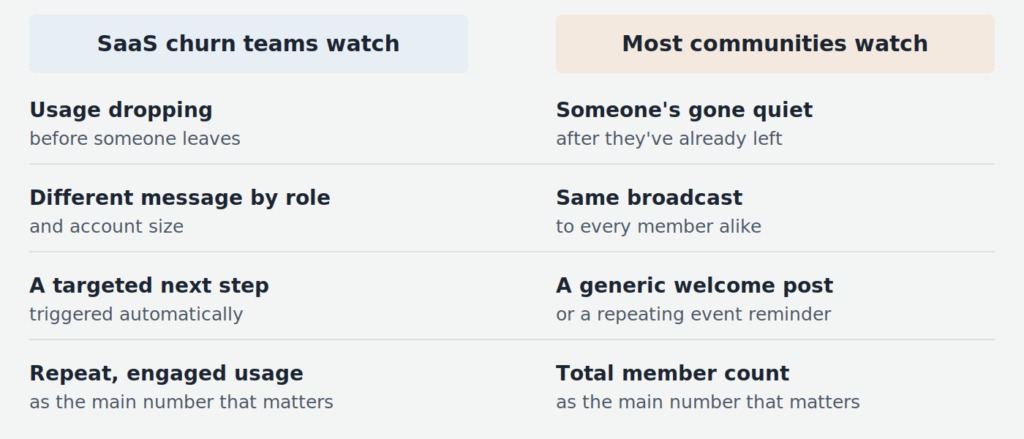
Most community managers manage toward vanity metrics like total member count or message volume. Meanwhile, B2B SaaS Customer Success (CS) teams treat churn as an operational science based on telemetry, health scores, and automated interventions. By adapting SaaS retention strategies into actionable community retention playbooks, you can convert passive, disengaged spaces into predictable value engines.
SaaS teams don’t wait for a customer to cancel to find out something’s wrong. They watch for usage dropping before the renewal date. Most communities do the opposite noticing someone’s gone quiet only after they’ve already stopped showing up.
In plain terms: get a new member to their first genuinely useful moment quickly don’t just greet them and hope.
SaaS calls this Time-to-Value, and builds automated paths that notice when someone hasn’t reached that moment yet, then nudge them toward it.
Manual version — no tools needed
Decide the one thing that makes someone feel “in” — getting a reply from another member, or showing up once. If a new member hasn’t hit that within 2 days, send them a personal message (write the template once, reuse it) pointing them to one specific thread or person.
In plain terms: instead of asking “how many members do we have,” ask “who’s about to stop showing up, and how would I know before they’re gone?”
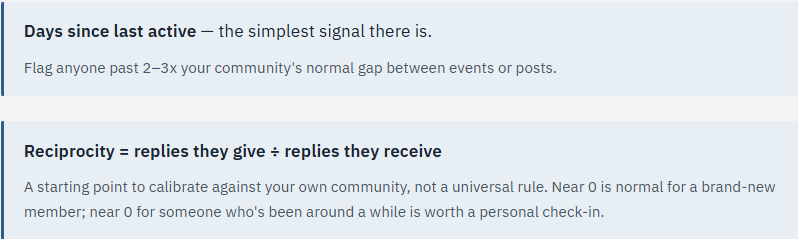
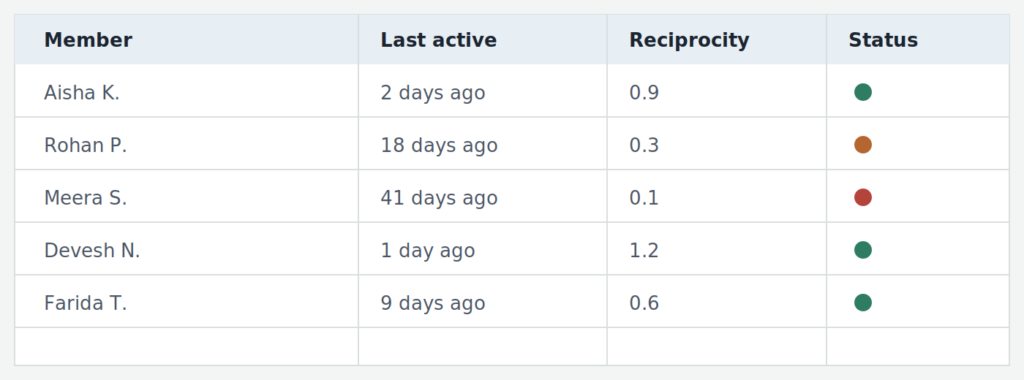
Two signals worth tracking even in a plain spreadsheet:
Manual version — no tools needed
One spreadsheet row per active member: last-active date and a rough reciprocity note, updated weekly. Anyone crossing your inactivity threshold gets a personal message, not an automated one.
In plain terms: don’t wait for someone to vanish silently — decide in advance what you’ll do when engagement starts dropping.
Manual version — no tools needed
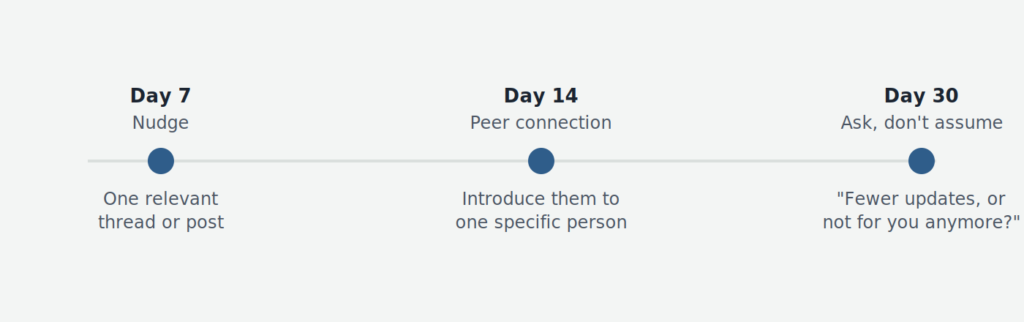
Three saved message templates, sent by you when someone crosses your inactivity threshold. No automation required to start — just a habit and a weekly spreadsheet check.
150 members, weekly Saturday run. The member count alone says 150 but a closer look shows 40 people haven’t posted or RSVP’d recently. Checking reciprocity, half of those 40 actually replied to someone else’s message in the past month they’re quiet, not gone. Of the remaining 20 genuinely inactive: 8 are new joiners past their first two weeks, so they get a Day-7 nudge pointing to next Saturday’s route. The other 12 have been silent over a month, so they get the Day-30 question directly. A few come back the following Saturday. A couple reply that they’ve moved cities. Either way, the organizer now knows something real instead of just watching the member count sit at 150 while Saturdays quietly feel emptier.
None of this needs software to begin. A single spreadsheet tab does the job until it doesn’t.
SaaS churn scoring optimizes for one clear finish line: a renewed contract. Community doesn’t have an equivalent someone can matter to a community without ever “converting” to anything measurable. The honest addition SaaS logic misses is this: automation should free up time for a real, unscripted conversation, not replace it. A Day-14 peer introduction still needs an actual person on the other end who means it. Borrow the structure. Don’t borrow the coldness.
Running this by hand in a spreadsheet works, and it’s worth doing manually first you’ll understand your own community’s rhythm before automating anything. Once the spreadsheet becomes the hard part, that’s usually the sign to bring in something built for it. That’s the exact gap Pinch is built to close: tracking who’s actually engaging, not just who joined, without stitching together five different tools.