
SMART Goals for Community Growth: The Complete Guide

SMART Goals for Community Growth: The Complete Guide

  • September 10, 2026

How the SMART Framework Drives Growth

Setting SMART goals for community growth is the difference between a strategy doc that sits untouched for a year and one your team actually executes. ‘Grow the community’ sounds motivating, but it never tells anyone what to do on Tuesday because it was never actually a goal to begin with. Many Community Managers and Founders start with high energy but fizzle out when their efforts don’t translate into tangible results.

The missing link? Focus.

At Pinch, we know that true community magic happens when you spend less time on admin and more time on people. But to know where you are going, you need a precise map.

Enter the SMART Framework.

Whether you are launching a new community or scaling an existing one, applying SMART ensures your goals are specific, measurable, achievable, relevant, and time-bound. Stop guessing and start growing.

What is the SMART Framework?

The SMART framework transforms vague ambitions into concrete plans. Instead of saying, “We want to grow our community,” you say exactly how you will do it.

Here is the breakdown of the acronym tailored for community growth:

🎯 Specific

What exactly do you want to achieve? Vague goals lead to scattered efforts. Narrow down your focus to a single area.

  • Bad Goal: “Increase engagement.”
  • SMART Goal: “Increase the number of daily active members in our Slack channel.”

📊 Measurable

How will you know when you’ve reached it? If you can’t track it, you can’t optimize it. Attach a number or metric to your goal.

  • Bad Goal: “Get more newsletter sign-ups.”
  • SMART Goal: “Grow our weekly newsletter subscriber list by 15%.”

🧗 Achievable

Is this goal realistic given your resources? Stretching is good; breaking is bad. Consider your budget, time, and team size.

  • Bad Goal: “Reach 1,000,000 members in 30 days (with zero budget).”
  • SMART Goal: “Convert 50 existing free members into paid annual subscribers this quarter.”

🧩 Relevant

Does this goal align with your core mission? Don’t chase vanity metrics. Ensure the goal actually helps the community thrive.

  • Bad Goal: “Get 10,000 Twitter followers (when your community is hosted on a private Discord).”
  • SMART Goal: “Increase event attendance by 20% by improving our email notification sequence.”

⏱️ Time-Bound

When will this goal be completed? An open-ended goal lacks urgency. Set a strict deadline to create focus.
  • Bad Goal: “Launch our ambassador program.”
  • SMART Goal: “Onboard our first cohort of 10 Community Ambassadors by October 31st.”
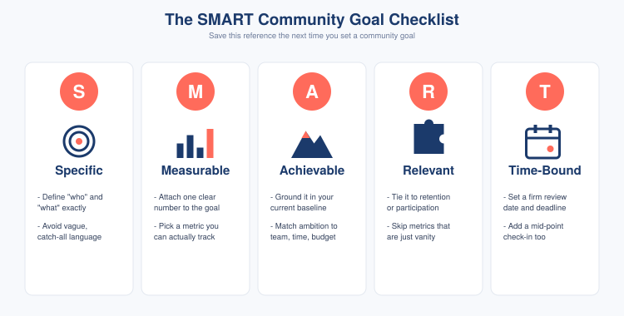
The SMART Community Goal Checklist

The SMART Community Goal Checklist

SMART in Action: 3 Real-World Scenarios

How does this look when the rubber meets the road? Let’s look at three common community objectives and how Pinch automates the processes required to hit them.

Scenario 1: Boosting Event Attendance

The Goal: Increase average monthly workshop attendance from 20 to 50 people by the end of Q2.

  • Why it’s SMART: It’s specific (workshop attendance), measurable (20 to 50), achievable (a realistic jump over 3 months), relevant (brings value to members), and time-bound (end of Q2).
  • How Pinch Helps: Manual tracking and emailing are exhausting. Pinch automates event registration, ticketing, and reminder sequences, ensuring maximum turnout with zero administrative lift from you.

Scenario 2: Improving Member Retention

The Goal: Reduce monthly churn rate from 8% to 4% by September 1st.

  • Why it’s SMART: It targets a specific metric, sets a clear benchmark, focuses on retention health, and has a hard deadline.
  • How Pinch Helps: Churn often happens when members feel disconnected. Use Pinch to automate personalized on-boarding sequences and trigger check-in messages based on member activity levels, re-engaging them before they leave.

Scenario 3: Launching a Paid Tier

The Goal: Convert 100 existing free members to a new $49/year ‘Founding Member’ tier within the first 30 days of launch.
  • Why it’s SMART: It defines the audience, sets a precise revenue/conversion target, and creates urgency with a 30-day window.
  • How Pinch Helps: Setting up payment gateways and managing access manually is a nightmare. Pinch handles memberships, automated billing, and gated access, allowing you to launch the new tier instantly.
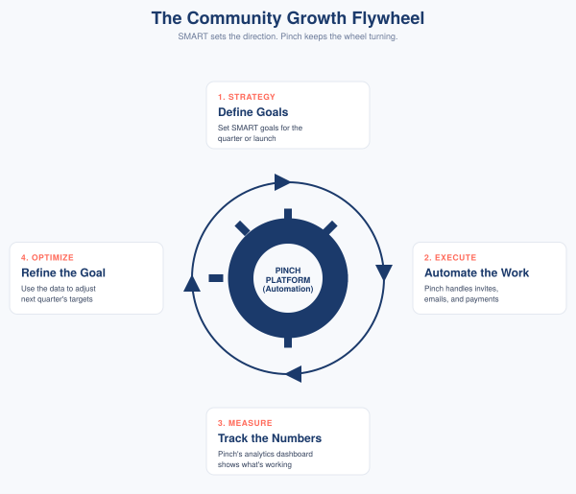
The Community Growth Flywheel

The Community Growth Flywheel

Key Takeaways: SMART Goals for Community Growth

You don’t need to be a data scientist to use SMART. You just need to be intentional.

  1. Pick ONE Metric: Don’t try to improve everything at once. Focus on the single biggest bottleneck in your community right now.
  2. Audit Your Time: If you spend 80% of your time on admin (sending links, chasing payments) and only 20% on connecting with members, you cannot grow effectively.
  3. Let Technology Handle the ‘How’: Once you set your SMART goal, use Pinch to execute the repetitive tasks required to meet it.
  4. Review Monthly: SMART goals are not set-and-forget. Review your progress on the Pinch analytics dashboard on the first of every month and adjust as needed.

Ready to Stop Guessing and Start Growing?


Use this framework to set your own SMART goals for community growth and let Pinch handle the tracking underneath them.

By automating your engagement, memberships, and events, Pinch frees you from the busy work so you can focus entirely on hitting your ambitious community growth goals.

Stop managing admin. Start building community.