
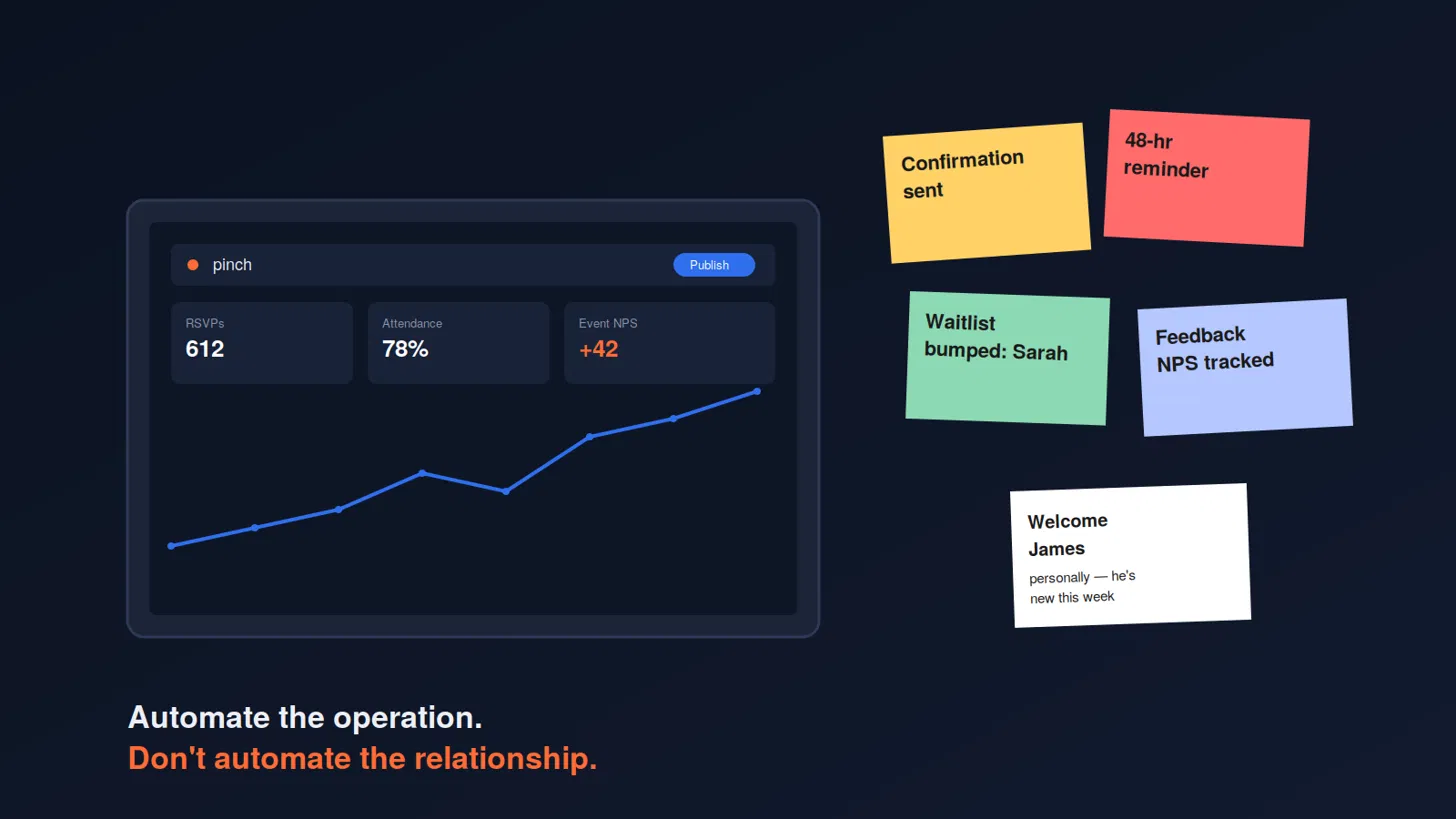
Here’s the rule before the reasoning: automate the operation, not the relationship. Everything in this piece is about figuring out where that line sits for your community and knowing how to check it whenever a new task or tool comes along. The distinction isn’t about how much you automate. It’s...
Read more
Most community events underperform. Not because the topic was wrong or the organiser did not care but because the event was planned around the organiser’s convenience rather than the member’s experience. The member forgot it was happening. The RSVP process was friction-heavy. Nobody followed up after. The feedback was...
Read more
What Is Community Management? Community management is the practice of building, nurturing, and sustaining an engaged group of people around a shared interest, identity, or goal. A community manager creates the conditions for members to connect with each other, participate in events and discussions, and find genuine value in...
Read more
Most communities fail before they reach 100 members. Not because the organiser lacked passion. Not because the topic was wrong. Not because the platform was bad. They fail because they were built for the organiser’s goals not the members’ needs. A member-first community flips that equation. Every structural decision ...
Read more
A member-first community is a group online, offline, or hybrid where every decision about membership, events, content, and engagement is made around the needs of members rather than the goals of the hosting organisation. It is the opposite of a broadcast community, where a brand pushes content at an...
Read more
Customer acquisition is getting harder for communities. Paid channels are saturated.Organic reach is declining.Trust in traditional marketing is weakening. For years, growth depended on one thing:spend more to acquire more. But that model is breaking. In 2026, a different approach is emerging one where growth is not just driven...
Read more
Customer acquisition costs are rising. Paid channels are getting expensive.Organic reach is declining.Competition is increasing. For many companies, scaling growth now means spending more to acquire the same customer. But there’s a shift happening. High-performing companies are using community as a growth system not just for engagement, but to reduce...
Read more
For many companies, community still sits on the edge of the business. It’s seen as: A support channel A marketing experiment A place for engagement But high-performing companies are treating community differently. They see it as a retention engine and a continuous source of product insight. In 2026, the...
Read more
Community burnout is one of the most common and least discussed challenges in community building. It doesn’t happen overnight.It builds slowly. Fewer replies.Lower energy.Delayed responses.Eventually, silence. Most teams respond by doing more: More content More events More prompts But burnout isn’t caused by lack of effort.It’s caused by unsustainable...
Read more
Communities are evolving. Open groups and public forums helped communities grow quickly, but they often struggle with noise, low engagement, and weak member connections. That’s why many organizations are now shifting toward invite-only communities. Invite-only communities prioritize quality over scale. They create spaces where members feel safe to share...
Read more