

Most communities fail before they reach 100 members.
Not because the organiser lacked passion. Not because the topic was wrong. Not because the platform was bad. They fail because they were built for the organiser’s goals not the members’ needs.
A member-first community flips that equation. Every structural decision who gets to join, what events get run, how members connect, what success looks like is made through one lens: does this serve our members?
The result is a community that members show up to, stay in, and tell their peers about. Not because they have to. Because they genuinely want to.
This guide gives you the exact framework to build one from scratch in 2026 whether you are starting with zero members or rebuilding a community that has gone quiet.
Most community builders begin by asking: “What do I want to get out of this community?”
More customers. More brand awareness. A captive audience for content.
Those are legitimate business goals. But if they are the first question you ask, they will shape every decision you make after and members will feel it. They always do.
The member-first builder asks a different first question: “What would make my ideal member genuinely glad they joined?”
Not “what can I offer them.” Not “what will keep them engaged with my content.” What would make them feel, six months from now, that joining this community was one of the best professional or personal decisions they made this year?
Start there. Keep coming back to it. Every time you face a community decision what event to run, who to approve, what to post, how to measure success ask that question first.
That is the entire philosophy. The rest is structure.
The biggest mistake community builders make is defining their audience too broadly.
“Entrepreneurs.” “Marketers.” “People who love fitness.” “Small business owners.”
These are audiences. They are not communities.
A community requires a level of shared context that makes peer-to-peer value possible. If your members have nothing specific enough in common, they have nothing specific enough to talk about, learn from each other about, or connect over.
The test of a good member definition is this: if two of your ideal members met at a party, would they immediately have things to talk about? Not generic things specific, substantive things that matter to them professionally or personally?
If the answer is yes, your definition is specific enough. If the answer is maybe, tighten it.
Complete this sentence:
“My ideal member is a [specific role] who is actively [specific challenge or goal] and wants to connect with peers who are [specific shared context].”
Some examples of how this looks in practice:
Notice what each of these definitions has: a specific role, a specific stage, a specific active goal, and a specific peer connection they are looking for.
With a definition this precise, you know who to approve, what events to run, what conversations to seed, and what your community’s success actually looks like.
Every successful member-first community in 2026 is specific. Not exclusive in an elitist sense specific in a way that makes every member feel like this community was built exactly for them.
A general fitness community has hundreds of competitors and no way to stand out. A community specifically for masters athletes (40+) training for their first triathlon has almost no competitors and an immediately obvious value proposition to its ideal member.
Specificity is not a limitation. It is your moat.
This is the decision most community builders get wrong and it is almost impossible to fix retroactively.
An open community where anyone can join instantly with no friction communicates one thing to potential members: everyone is welcome here, including people who do not belong. That signal degrades the experience for the members who do belong, because the signal-to-noise ratio is low and peer connections feel less reliable.
A curated community where joining requires some form of intent, verification, or approval communicates the opposite: the people in here were chosen, or at least chose deliberately. That signal increases the value of every connection inside the community.
Here are the four access models available to you, from least to most curated:
Anyone can join, but they must complete a real profile before accessing the community. Name, role, location, what they are working on, what they want from the community.
This is the minimum viable curation. It filters out bots and casual lurkers, and it immediately makes the member directory useful. Most people who would not contribute meaningfully will not bother completing a real profile.
Best for: communities in early growth stage that need volume before they can be more selective.
New members submit a short application typically 3–5 questions and an organiser reviews and approves or declines within 24–48 hours.
The application does not need to be rigorous. The act of completing it is itself a filter. People who want access badly enough to answer five honest questions are meaningfully more committed than people who clicked “join” in a moment of casual interest.
Best for: professional communities, niche interest groups, and any community where the quality of members is the primary product.
New members can only join through a referral from an existing member. Existing members vouch for the people they invite which creates a culture of shared responsibility for the community’s quality.
This model grows more slowly, but every member who joins is pre-validated by someone already inside. The trust level between members is higher, and the community’s culture is more durable because every member was brought in by a peer, not by a marketing campaign.
Best for: founder networks, mastermind groups, high-trust professional communities, and any community where exclusivity is part of the value proposition.
Multiple membership levels unlock different parts of the community. A free or lower tier gives access to public content and basic events. A paid or higher tier gives access to premium events, the full member directory, small-group experiences, and deeper programming.
This model lets you grow a broad base while creating genuine depth and exclusivity at the higher tiers.
Best for: communities that want to monetise without restricting access entirely, and for organisations that want to use community as part of a product or service ladder.
If you are starting from zero: begin with application-based membership. It gives you enough curation to start with a high-quality cohort, while still being achievable without a large existing audience.
If you already have an audience: consider invite-only. Your existing followers can be your first cohort, and their referrals will bring in peers who fit.
If you want to monetise from day one: design a tiered model with a clear value proposition at each level.
Whatever model you choose, set it up before you invite anyone. Retrofitting an access model onto a community that has already grown is one of the most disruptive things you can do to member experience.
Your platform is not just a technical choice. It is a structural one. The features your platform has or does not have will shape what your community can and cannot do.
Most communities are built on platforms designed primarily for content distribution: Facebook Groups, Slack, Discord. These platforms are optimised for broadcast and conversation. They are not optimised for member management, event coordination, or the kind of structured peer connection that makes a member-first community work.
Here is what a platform built for member-first communities needs to do:
Members need to be able to find each other based on relevant attributes role, location, interests, what they are working on. A member directory that is rich, searchable, and kept current is one of the most powerful features a community platform can offer.
Without it, peer-to-peer connection relies on luck whoever happens to be active in the same thread at the same time. With it, any member can find three relevant peers and reach out within minutes of joining.
Your platform needs to support your chosen access model natively. Customisable join forms, approval queues, invite link management, and membership tiers are not optional extras they are the infrastructure of curation.
Events are the heartbeat of a member-first community. Your platform should let you create events, manage RSVPs, send automated reminders, handle waitlists, and capture post-event feedback without requiring a separate tool for each step.
Every additional tool in your stack is another login, another integration point, and another place for things to break.
As your community grows, you cannot personally welcome every new member, nudge every inactive one, or remind every event attendee. A platform with smart engagement automation welcome sequences, re-engagement triggers, event reminders, and activity nudges lets you maintain the feeling of a personally-run community at any scale.
Your platform’s analytics should tell you: who is active, who is at risk of churning, what events drive the highest attendance, and how member engagement has trended over the last 90 days. Not impressions, not post reach member outcomes.
Pinch is built specifically for these requirements. Every feature verified profiles, approval workflows, event management, engagement automation, and retention analytics is designed around the member-first model. It is what separates a community management platform from a chat tool with a members list.
Before you invite your first member, build the infrastructure that will make their first 48 hours exceptional.
The first 48 hours are everything. Research on online community behaviour consistently shows that members who make a peer connection, attend an event, or contribute to a conversation within their first two days are dramatically more likely to still be active members six months later. Members who join and hear nothing or find nothing immediately relevant to them churn silently and never come back.
Here is the onboarding flow that works:
Automated is fine. Personal feels better. Either way, every new member should receive a welcome message that:
That last element the personal introduction is the single most high-impact action in your entire onboarding flow. A new member who receives a message saying “I thought you and [Name], who is also working on [specific shared thing], should connect” will feel seen immediately. That feeling is the foundation of belonging.
Send a follow-up prompt asking new members to complete their profile if they have not already. Make the ask specific: “A complete profile means other members can find you when they are looking for someone with your background. It takes about three minutes.”
Tell them what happens after that their profile will appear in the member directory, that other members will be able to search for and reach out to them, and that you personally review profiles to make peer introductions.
A brief, personal-feeling message from the community organiser. Not a newsletter. Not a product announcement. A genuine check-in: “How is your first week going? Is there anything specific you were hoping to find here that you have not found yet?”
This message accomplishes two things. It signals that the organiser is present and paying attention. And it gives new members an easy opening to share what they actually need which is gold for your programming.
Your events calendar is the most direct expression of your community’s values. What you choose to run tells members exactly what this community thinks is important.
A member-first community plans events by asking: what do our members need to get better at, figure out, or connect around right now?
Not: what do we want to promote? Not: what fits our content calendar? What do members need?
Before you plan a single event, send a survey to your first cohort of members. Keep it short three to five questions:
The answers to these questions contain your entire programming strategy for the first quarter. Use them.
Format 1: The peer roundtable (virtual or in-person)
Eight to twelve members, one facilitator, one focused question. No slides, no keynote, no expert talking at people. Just peers with shared context working through a real challenge together.
This format does more for peer-to-peer connection than any other because it requires every person in the room to contribute. Members leave having heard each other’s actual thinking, not a presentation. They leave knowing each other.
Best for: professional communities, founder networks, and any community where the peer expertise in the room is the product.
Format 2: The member spotlight
One member presents something they have built, learned, or figured out 20 minutes of content, 20 minutes of Q&A from peers. No professional speakers, no brand content. Pure member expertise.
This format does two things at once: it surfaces the expertise already inside your community, and it gives ambitious members a reason to stay and contribute. Being featured is a form of recognition. Recognition drives retention.
Best for: communities where professional development is a primary value proposition.
Format 3: The social or in-person meetup
No agenda. No content. Just members in a room (virtual or physical) with a simple prompt to start conversations. The less structured this is, the better the moment you introduce a presentation, you turn participants into an audience.
This format is underused by community builders who feel they need to justify events with content. But the most memorable community experiences are almost always the ones where members simply met each other in a context that felt low-pressure and genuine.
Best for: early-stage community building when you are trying to create the feeling of belonging before the programming is fully developed.
Every event should end with a one-minute feedback form: what was most valuable, what was missing, what should we do next? Three questions maximum.
Collect this data, read every response, and let it shape your next event. Then tell your members you did “Based on your feedback from last month’s roundtable, we are going to try a smaller format next time.” This closes the loop and demonstrates, visibly, that you are building this community for them.
Events bring members together. Peer connections keep them there.
A member-first community invests actively in the infrastructure that lets members find and connect with each other not just with the organiser or the community’s content.
Here is what that infrastructure looks like in practice:
Every member can search the directory by role, interest, location, or what they are working on. New members can immediately find three to five people who share their specific context and reach out directly.
This sounds simple. It is transformative. The moment a new member finds a peer who is doing exactly what they are doing facing the same challenges, working on the same problems the community stops feeling like a content channel and starts feeling like a professional home.
Once a week, make two or three intentional introductions: “I thought you two should connect because [specific reason].” These do not need to be elaborate. They just need to be specific generic “you both like marketing” introductions are ignored. Specific “you are both navigating the transition from agency to in-house, and I thought you might want to compare notes” introductions get responses.
At scale, Pinch’s engagement automation can handle this with smart member matching surfacing relevant peer connections based on profile attributes and activity data, and sending personalised introduction prompts without the organiser doing it manually.
As your community grows past 100 members, create sub-groups around specific interests or roles within the community. Not everyone needs everything a community of 200 members with five active sub-groups of 30–40 each will produce more genuine connection than one big room where everyone is trying to stay relevant to everyone else.
A space where members can ask questions and get answers from peers not from the organiser. Seed this early by asking members to share real questions they are grappling with, and resist the temptation to answer everything yourself. Your job is to surface the question and tag two or three members who are likely to have relevant experience. Let them answer. Let peer expertise be the star.
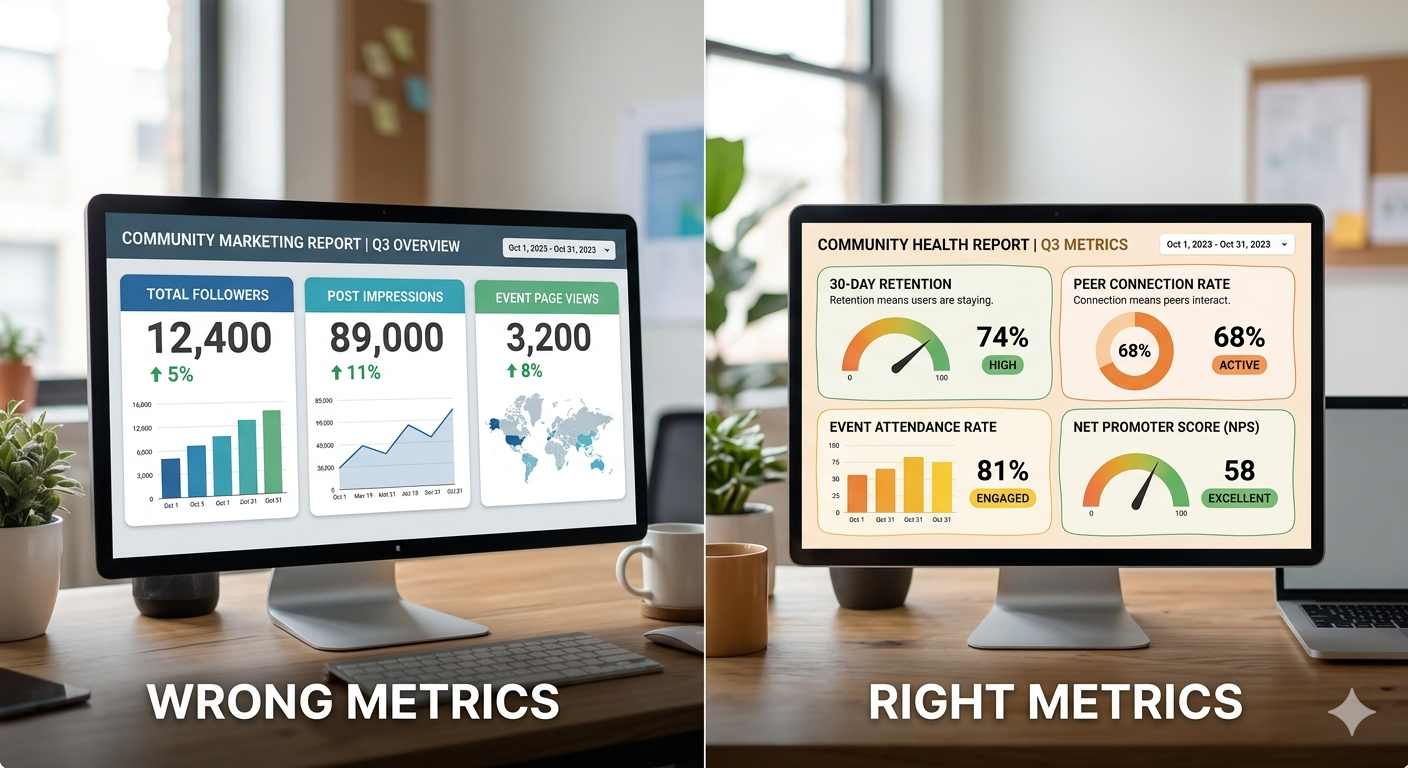
A member-first community tracks a different set of numbers:
Of every member who joins, what percentage is still active at 30 days? At 90 days? Activity can be defined as: logged in, attended an event, or engaged with another member in the last 30 days.
These numbers tell you the truth about your community faster than anything else. A 30-day retention rate above 65% is healthy for a new community. A 90-day retention rate above 50% is strong. If either number drops below 40%, there is a structural problem to investigate not patch, investigate.
Of members who RSVP to an event, what percentage actually shows up? Low RSVP-to-attendance rates (below 60%) are a signal that events are not relevant enough to members to compete with everything else in their calendar. High rates (above 75%) signal that members genuinely anticipate your events.
Are members reaching out to each other, or are all interactions flowing through the organiser? Track direct messages between members, introduction acceptance rates, and whether sub-group conversations are peer-led or organiser-led. A healthy community has a high ratio of peer-to-peer to broadcast activity.
Once a quarter, ask your members one question: “On a scale of 0–10, how likely are you to recommend this community to a colleague?” An NPS above 50 is excellent. Below 30 signals that something is missing for members.
Follow up with one open-ended question: “What is the one thing that would make you more likely to recommend us?” The answers are your product roadmap.
Read every piece of feedback your members give you event surveys, onboarding check-ins, NPS comments. The specific language members use to describe what they value tells you exactly what to keep doing. The specific language they use to describe what is missing tells you exactly what to build next.
The most durable community growth strategy is also the simplest: make the community so valuable to members that they recruit for you.
Member-first communities that are working well do not need to advertise. Their members do it for them in conversations with colleagues, in recommendations to friends, in public posts about what they have learned or built or found inside the community.
Your job is to create the conditions for that organic advocacy:
Make members famous inside the community. Spotlight member wins, expertise, and contributions publicly and frequently. People who feel recognised stay and recruit. People who feel invisible churn.
Give members easy ways to invite peers. Personalised invite links, referral incentives (even simple ones like priority access to premium events), and a frictionless application process for referred members all lower the activation energy of member-driven growth.
Build rituals that members talk about. The annual in-person gathering. The weekly problem-solving thread that always produces one unexpected insight. The monthly member spotlight that everyone looks forward to. Rituals create shared identity and shared identity creates the stories members tell about the community to people who are not yet in it.
Ask directly. Once a quarter, send your most engaged members a simple message: “You have been one of our most active members this year. Is there one person in your network who you think would genuinely benefit from this community? I would be happy to expedite their application.” The answer rate on this message, from genuinely engaged members, is higher than you would expect.
The pressure to show growth metrics member count, event numbers, monthly sign-ups tempts community builders to open the door wider than the community is ready for. The result is a diluted membership, a generic culture, and a flood of new members who do not find the peer density they were expecting.
Grow deliberately. Quality of membership compounds. Ten highly engaged members will recruit twenty more like them. Five hundred disengaged followers will recruit no one.
If your members are primarily based in one timezone and you schedule events for your convenience, attendance will be low and morale will be lower. Survey your members on timing before building your events calendar. Adjust as your community’s geography changes.
If the organiser is the most active person in every conversation, the community is not a community it is an audience. Deliberately seed conversations you do not answer, facilitate discussions you do not dominate, and run events where you are the host, not the star. Your members’ expertise is the product. Surface it.
High post counts, high event registrations, high member counts these numbers can coexist with a community that is not actually delivering value to its members. Track what matters: retention, peer connections, NPS. Let those numbers drive your decisions.
The first 48 hours are everything. A member who joins and hears nothing or finds nothing relevant on their first visit is already halfway out the door. Invest in your onboarding infrastructure before you invest in your growth strategy. Retention is cheaper than acquisition, always.

Here is what the first 90 days of building a member-first community looks like in practice:
Days 1–14: Foundation Write your ideal member definition. Choose your access model. Set up your platform. Build your member profile requirements and approval workflow. Write your welcome sequence, profile prompt, and first-week check-in.
Days 15–30: First cohort Personally invite 20–30 ideal members people you know, people referred by people you know, people who fit your member definition precisely. Make every introduction personal. Send every welcome message as if you wrote it yourself, even if it is automated.
Days 31–60: First events Run your first two events one roundtable format, one member spotlight. Collect post-event feedback after both. Send your first quarterly member survey at day 45. Use the responses to plan your next two events.
Days 61–90: Peer connection focus Make five intentional member-to-member introductions each week. Launch your first interest-based sub-group. Review your 30-day retention data and investigate any early churn signals. Ask your three most engaged members for one referral each.
At 90 days, you will not have a large community. You will have a real one, a small, dense, active group of members who are genuinely glad they joined, who know each other, and who have the beginning of a shared identity. That is the foundation everything else is built on.
Building a member-first community from scratch is not complicated. But it requires choosing, at every step, to prioritise what members need over what the organiser wants.
Define your ideal member precisely. Design a curated access model. Set up a platform that handles membership management, events, and engagement automation in one place. Build your onboarding infrastructure before you invite anyone. Plan events around member goals. Create the conditions for peer-to-peer connection. Measure retention, not followers.
Do those eight things consistently, and you will build a community that members stay in, contribute to, and recruit for without you having to push any of it.
Pinch is the all-in-one platform for member-first communities. Verified profiles, curated access controls, integrated event management, engagement automation, and retention analytics everything you need to build and run a community your members will never want to leave. Start building for free →
How long does it take to build a member-first community from scratch? The first cohort of 20–30 genuinely engaged members can be assembled in 30 days if you are starting with an existing network. Reaching a self-sustaining community one where peer connections and word-of-mouth drive growth without the organiser pushing it typically takes 6–12 months of consistent effort.
How many members do you need before a community starts feeling alive? Somewhere between 50 and 150 active members, depending on how niche the community is. Below that threshold, peer density can feel thin not enough people for members to always find relevant connections. Above 150, sub-groups become necessary to maintain the intimacy that makes member-first communities work.
What is the best platform for building a member-first community? The best platform is one that supports curated membership management, integrated event tools, engagement automation, and analytics built around member outcomes not just content metrics. Pinch is built specifically for this use case.
How do you keep members engaged long-term? Long-term engagement comes from three things: regular programming that is genuinely relevant to members’ goals, active peer-to-peer connection infrastructure, and visible responsiveness from the organiser to member feedback. Members who feel heard, connected, and consistently challenged stay for years.
Should a member-first community be free or paid? Both models work. Paid communities tend to have higher engagement because members have invested in belonging. Free communities with a strong application process can also achieve high engagement if curation replaces price as the barrier to entry. The worst-performing model is free and open to everyone no investment, no curation, no signal that belonging here means something.
How do you handle members who are not a good fit? Set community guidelines clearly from day one and enforce them consistently. When a member is not contributing positively spamming, being disrespectful, using the community as a pure lead generation tool a private, direct conversation is the first step. Most people respond well to honest feedback. If behaviour does not change, removing a member protects the experience of every other member in the community. Member-first means prioritising the members who are contributing.
Published by Pinch – the AI-powered community and event management platform built for curated, member-first communities. addpinch.com