
A member-first community is a group online, offline, or hybrid where every decision about membership, events, content, and engagement is made around the needs of members rather than the goals of the hosting organisation. It is the opposite of a broadcast community, where a brand pushes content at an audience.
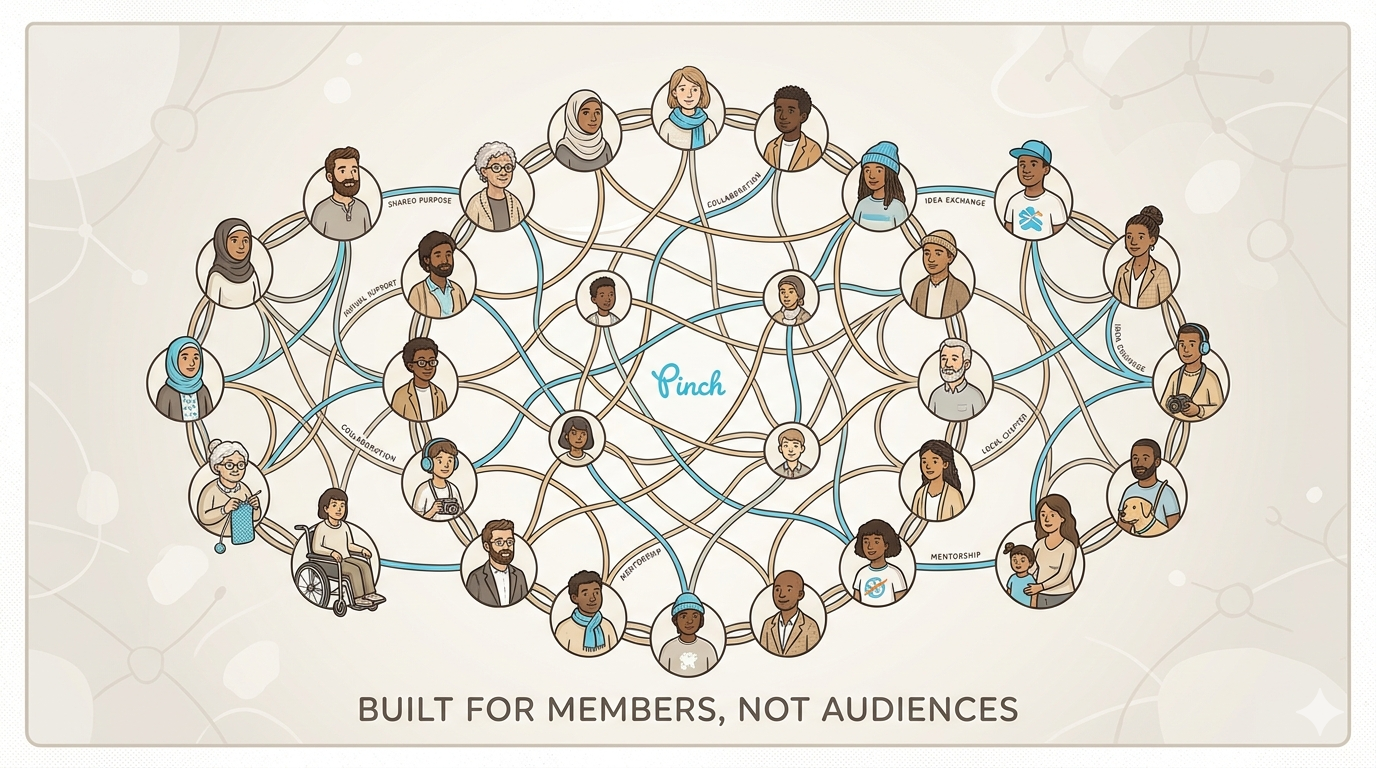
If you have ever joined a group that felt genuinely alive where people knew each other, showed up for events, and stayed for years you have experienced a member-first community. If you have ever joined a brand’s community and quietly ghosted after two weeks of promotional emails, you have experienced the alternative.
The difference is not accidental. It is structural.
This guide explains exactly what a member-first community is, why it outperforms every other community model on retention and engagement, and how you can build one from scratch in 2026 even without a large team or a big budget.
Part 1: The definition of a member-first community
A member-first community is defined by a single, repeatable question that its organisers ask before every decision:
“Does this serve our members?”
Not: does this serve our marketing goals? Not: does this fit our content calendar? Not: does this sell more of our product? Those questions are not irrelevant but in a member-first community, they come second. Always.
This philosophy shapes everything: who gets to join, what events get planned, what conversations get facilitated, how members are recognised, and how success is measured.
What member-first is not
Before going further, it is worth being clear about what member-first does not mean:
- It does not mean the host organisation has no voice or goals. Member-first communities can and should serve business objectives but those objectives are achieved through genuine member value, not instead of it.
- It does not mean every member gets everything they want all the time. Curation, boundaries, and structure are features of the model, not contradictions of it.
- It does not mean the community is free or nonprofit. Plenty of paid, for-profit communities operate on a member-first model. The philosophy is about priority, not price.
The formal definition
Member-first community (noun): A structured group online, offline, or hybrid in which the primary design consideration is the value, experience, and belonging of its members. Programming, access policies, engagement mechanics, and success metrics are all oriented around member outcomes rather than organisational promotion.
Part 2: The 4 core principles of member-first communities
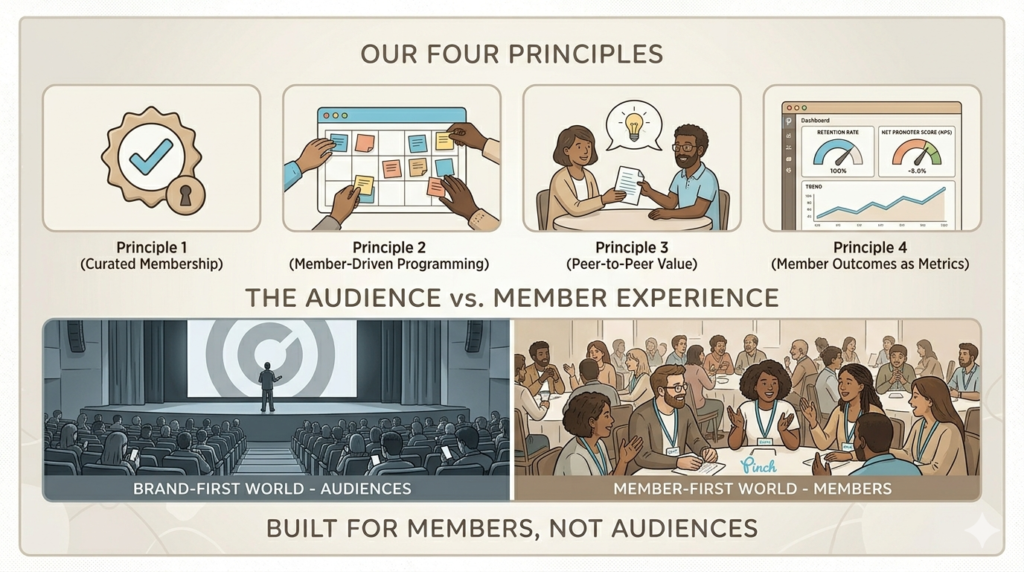
Every member-first community, regardless of size, industry, or format, operates on four foundational principles. These are not aspirational values they are structural decisions that show up in how the community is actually built and run.
Principle 1: Curated, not open-door membership
Member-first communities are selective by design. This is one of the most counterintuitive aspects of the model for organisers who equate community size with community success.
An open-door community lets anyone join instantly. The barrier to entry is zero, which means the signal-to-noise ratio is also close to zero. Members show up, find nothing relevant to them, and leave within days. The community looks large by follower count and hollow by every other measure.
A member-first community uses one or more of the following mechanisms to maintain curation:
Verified member profiles. Every member completes a real profile their name, role, interests, and what they bring to the community. This immediately raises the quality of the membership and makes the directory genuinely useful for peer connection.
Approval workflows. New join requests are reviewed before access is granted. This takes time upfront but dramatically improves retention because every member who gets in is there for the right reasons.
Invite-only access. The community grows through member referrals. Existing members vouch for new ones. This creates a culture of responsibility and shared standards that open communities simply cannot replicate.
Tiered access. Different membership levels unlock different parts of the community events, forums, resources, or direct member connections. This gives members something to grow into and gives organisers a way to reward genuine engagement.
Pinch supports all four of these mechanisms natively from customisable join approval flows to verified member profiles and smart access tiers precisely because curation is not optional in a member-first model.
Principle 2: Member-driven programming
In a brand-first community, the calendar is set by the marketing team. Events are timed around product launches. Content is written to address objections. Webinars exist to move people down the funnel.
In a member-first community, the programming is shaped by what members actually want to learn, discuss, and do together. This does not mean the organiser has no role it means the organiser’s role is to facilitate member interest, not to manufacture it.
Concretely, member-driven programming looks like:
- Running a short survey before each quarter to ask members what topics they want covered at events
- Creating a member-submitted speaker programme where peers present to peers
- Building recurring events around member habits (monthly roundtables, weekly office hours, annual in-person gatherings) rather than around content deadlines
- Using post-event feedback not just to rate the event, but to shape the next one
The result is a calendar that members look forward to because it was designed around them.
Principle 3: Peer-to-peer value over top-down content
This is the principle that separates thriving member-first communities from polished ghost towns.
Top-down content is content that flows from the organiser to the members: blog posts, announcements, tutorials, newsletters. It has its place. But it creates a passive audience, not an active community.
Peer-to-peer value is what members create for each other: introductions, advice, shared resources, collaborative projects, mutual accountability. It cannot be manufactured by the organiser it can only be structured for and facilitated.
Member-first communities invest heavily in the infrastructure for peer-to-peer value:
- Member directories that surface relevant connections. If a member can instantly find and reach out to three peers who share their exact challenge, the community has done something no newsletter ever could.
- Discussion formats that invite contribution. Not “here is our content react to it” but “here is a question what do you think?”
- Recognition systems that celebrate member contribution. Badges, spotlights, leaderboards, and personal acknowledgement from organisers signal that member input is valued and seen.
- Small-group experiences. Breakout rooms, mentorship pairings, and interest-based sub-groups give members a more intimate context to connect than a large public forum allows.
Principle 4: Member outcomes as the primary success metric
Most community platforms are optimised to make organisations look good: follower counts, post impressions, event page views. These are easy to measure and easy to report upward but they tell you almost nothing about whether your community is actually working for its members.
Member-first communities track a different set of metrics:
Member retention rate. What percentage of members who joined six months ago are still active today? This is the single most honest measure of whether the community is delivering value. A 30-day retention rate above 70% is strong. Anything below 40% signals a structural problem.
Member-to-member connections. Are members finding and connecting with each other, or are all interactions flowing through the organiser? A healthy member-first community has a high ratio of peer-to-peer engagement versus broadcast engagement.
Event attendance rate. Of members who RSVP to events, what percentage actually show up? High attendance is a sign that events are genuinely anticipated. Low attendance is a sign that events feel obligatory or irrelevant.
Net Promoter Score (NPS) for the community itself. Would your members recommend this community to a colleague? If the answer is a strong yes, you have built something genuinely valuable.
Member-submitted feedback quality. Not just the rating the text. What specific things do members say they value? What do they wish was different? This qualitative data is the most direct window into member experience.
Part 3: Member-first vs. brand-first, a detailed comparison
The distinction between member-first and brand-first communities is not always obvious from the outside. Both can have active events calendars, polished websites, and large member counts. The difference shows up in the data and in how members feel about belonging.
Membership approach
Brand-first: The goal is volume. More members means more reach, more potential customers, more data points. Joining is frictionless. Anyone can sign up in seconds.
Member-first: The goal is quality. More of the right members means a better experience for everyone already there. Joining requires effort a profile, an application, a referral, a wait. That effort is the first signal of genuine intent.
Programming philosophy
Brand-first: Events are planned around the organisation’s goals. The product launch drives the webinar. The campaign drives the content series. Members are the audience.
Member-first: Events are planned around member goals. The member survey drives the workshop. The peer interest drives the roundtable. The organiser is the facilitator.
Engagement model
Brand-first: Engagement is measured in reactions, clicks, and opens. The community is a channel. Members are a segment.
Member-first: Engagement is measured in connections, conversations, and outcomes. The community is a place. Members are a cohort.
Growth strategy
Brand-first: Grow by advertising, lead magnets, and open invitations. Size is the goal.
Member-first: Grow through member referrals, selective admissions, and reputation. Density is the goal.
Failure mode
Brand-first communities fail by becoming hollow large but inactive, full of members who never engage and content nobody reads.
Member-first communities fail by becoming insular so tight-knit that new members cannot break in, or so curated that the community stops growing altogether.
Understanding both failure modes helps organisers calibrate. Curation is necessary but it must be paired with active onboarding and programmatic ways to help new members find their footing quickly.
Part 4: Real examples of member-first communities in 2026
Example 1: Figma’s design community
Figma did not set out to build a marketing channel. They set out to create a place where designers could get better at their craft and find peers who shared their obsessions. The community’s events, resources, and discussions are driven by what the design community wants to explore not by what Figma wants to promote.
The result: a community that is so valuable to its members that Figma rarely needs to market directly. Members advocate for the product because they love the community, and they love the community because it was built for them.
What makes it member-first: peer-to-peer resource sharing, member-submitted design challenges, local chapters led by members, and events that exist to teach not to sell.
Example 2: Running clubs and fitness communities on Pinch
Some of the most genuinely member-first communities in the world are small, local, and offline. A running club of 80 members that uses Pinch to manage events, track attendance, and communicate between sessions is, in many ways, a perfect expression of the member-first model.
Members propose routes. Members vote on race targets. Members organise sub-groups for different pace bands. The organiser’s job is to handle the logistics event creation, reminders, post-event summaries while the members handle the culture.
Pinch’s engagement automation and event management tools are built specifically to make this kind of organiser-as-facilitator model sustainable without requiring a full-time community manager.
What makes it member-first: member-proposed programming, peer-to-peer accountability, and a verified member directory that makes it easy for new runners to find training partners.
Example 3: Independent founder networks
The most valuable professional networks in 2026 are not the biggest ones they are the most curated ones. Independent founder networks that operate on an application-only basis, with member-submitted content and peer-led discussions, consistently outperform open LinkedIn groups on every engagement metric.
These communities typically:
- Require a detailed application that screens for genuine fit
- Have a member-driven programming committee
- Measure success by introductions made, deals referred, and problems solved not by post engagement
- Grow slowly and intentionally through member referrals
What makes it member-first: the founding philosophy that the community’s value comes entirely from the quality of its members, not the brand behind it.
Example 4: Professional associations rebuilding for 2026
Many traditional professional associations medical societies, trade groups, alumni networks are undergoing a member-first transformation in 2026. Having spent decades as broadcast organisations (publishing journals, hosting annual conferences, sending newsletters), they are discovering that their members want peer connection, not more top-down content.
The associations winning in 2026 are those that have restructured around member-submitted programming, peer mentorship pairings, interest-based sub-communities, and event formats that prioritise networking over keynotes.
What makes it member-first: the deliberate shift from “we produce content, you consume it” to “you bring the expertise, we create the conditions for it to be shared.”
Part 5: How to build a member-first community in 2026
Building a member-first community is not primarily a technology problem it is a philosophy problem. You have to decide, before you build anything, that you are building for your members, not with your members as an audience. Once that decision is made, the structural choices follow naturally.
Here is the framework:
Step 1: Define who your members are precisely
Not “people interested in marketing.” Not “small business owners.” The more specific you are, the better the member-to-member value will be.
Write a one-sentence description of your ideal member: “A founder of a bootstrapped B2B SaaS company with between 5 and 50 customers, who is actively working on their go-to-market strategy.”
That specificity tells you who to approve, what events to run, what conversations to seed, and what success looks like.
Step 2: Design your access model before you open the door
Decide:
- Open, invite-only, or application-based?
- One membership tier or multiple?
- What does a completed member profile require?
- What is the process for reviewing and approving applications?
Set this up before you invite anyone. Retrofitting access controls onto an open community is far harder than starting curated from day one.
Step 3: Build your first event around a member goal, not a brand goal
Your first event should answer a question your ideal member is actively struggling with. Not a product demo. Not a brand introduction. A workshop, roundtable, or discussion that delivers genuine value to the people in the room and makes them want to come back.
Step 4: Create the conditions for peer-to-peer connection
On day one, send every new member a message (automated is fine, personal feels better) that introduces them to two or three existing members who share their background or goals. This single action dramatically increases the likelihood that they will engage within the first week which dramatically increases the likelihood that they will still be a member six months from now.
Step 5: Measure what actually matters
Set up tracking for:
- 30-day and 90-day member retention
- Event attendance rate
- Member-to-member connection rate (are members reaching out to each other?)
- Monthly Net Promoter Score
Review these monthly. Let them drive your programming decisions. When retention drops, investigate do not assume.
Step 6: Let members shape the next chapter
Once your community has 50+ active members, run a quarterly member survey. Ask: what do you love? What is missing? What would make you more likely to recommend this community to a peer? Use the answers to build the next quarter’s calendar.
This loop build, measure, ask, adapt is what separates member-first communities that grow from those that plateau.
Part 6: Why member-first communities win in 2026
The community landscape in 2026 is more crowded than it has ever been. Every brand has a community. Every platform has a group. Attention is fractured and members are selective they have learned, through painful experience, which communities are worth their time and which are just mailing lists wearing a different hat.
In this environment, the member-first model is not just ethically sound it is strategically superior.
It wins on retention. When members join a community and immediately find value through peer connections, relevant events, and genuine belonging they stay. The difference in 12-month retention between member-first and brand-first communities is not marginal. It is structural.
It wins on word-of-mouth. Members who feel genuinely served by a community become its most enthusiastic recruiters. They refer colleagues, mention it in conversations, and advocate for it without being asked. This organic growth is both cheaper and more durable than paid acquisition.
It wins on trust. In an era of AI-generated content and synthetic engagement, authenticity is a competitive advantage. A community that demonstrably puts its members first builds a level of trust that no amount of content marketing can replicate.
It wins on longevity. Brand-first communities rise and fall with the brand’s fortunes and marketing budgets. Member-first communities develop their own momentum members show up for each other, not just for the host. That momentum is extraordinarily hard to kill.
The tools that make member-first sustainable
The member-first philosophy requires more organisational discipline than a broadcast community but it does not require more time, if you have the right tools.
Pinch is built specifically for member-first community organisers. Every feature from verified member profiles and smart approval workflows to engagement bots and post-event analytics is designed around the same question the member-first philosophy asks: does this serve our members?
With Pinch, you can:
- Curate your membership with verified profiles and customisable approval workflows
- Run seamless events with automated RSVPs, reminders, speaker management, and post-event feedback in minutes, not hours
- Facilitate peer connections with a smart member directory that surfaces relevant members based on interests and activity
- Understand your community through clear dashboards that track the metrics that actually matter retention, attendance, and engagement
- Automate engagement with a 24/7 engagement bot that answers member questions, shares updates, and keeps conversations active without adding to your workload
Summary
A member-first community is one where the member experience is the top priority above brand goals, above content calendars, and above vanity metrics. It is built on curated membership, member-driven programming, peer-to-peer value, and success metrics that reflect member outcomes.
In 2026, as community fatigue increases and members grow more selective, the member-first model is not a nice-to-have. It is the only model that builds communities people actually stay in.
The good news: you do not need a large team or an enterprise budget to build one. You need a clear philosophy, the right structure, and tools designed to make the organiser’s job lighter so the member’s experience is richer.
Ready to build your member-first community? Pinch is the AI-powered platform built for curated, member-first communities. Manage memberships, run events, automate engagement, and grow a community your members will never want to leave. Get started free →
Frequently asked questions
What is a member-first community? A member-first community is a group online, offline, or hybrid, where every decision about membership, events, content, and engagement is made around the needs of members rather than the goals of the hosting organisation.
How is a member-first community different from a brand community? A brand community is built to serve the brand’s goals awareness, retention, and lead generation. A member-first community is built to serve its members’ goals learning, connection, and belonging. In practice, the best brand communities are member-first, because that is the only model that actually retains members long-term.
What are examples of member-first communities? Figma’s design community, professional founder networks, curated running clubs, and application-only industry associations are all examples of member-first communities. They share curated access, peer-driven programming, and metrics focused on member outcomes.
How do you build a member-first community? Start by defining your ideal member precisely, then design a curated access model before you open the door. Build your first event around a member goal, create the conditions for peer-to-peer connection from day one, and measure retention and engagement not follower counts.
What platform is best for a member-first community? Pinch is built specifically for member-first communities, offering verified memberships, invite-only access controls, engagement automation, smart member directories, and integrated event management in one platform.
How large does a member-first community need to be? Size is not the defining feature of a member-first community quality of membership and member outcomes are. A 50-person member-first community can deliver far more value to its members than a 50,000-person open group with low engagement.
Can a for-profit company run a member-first community? Yes. Member-first is a philosophy about priority, not a business model. Many for-profit companies run highly successful member-first communities that also serve clear business objectives because genuine member value and business value are not in conflict. They are, in the long run, the same thing.