
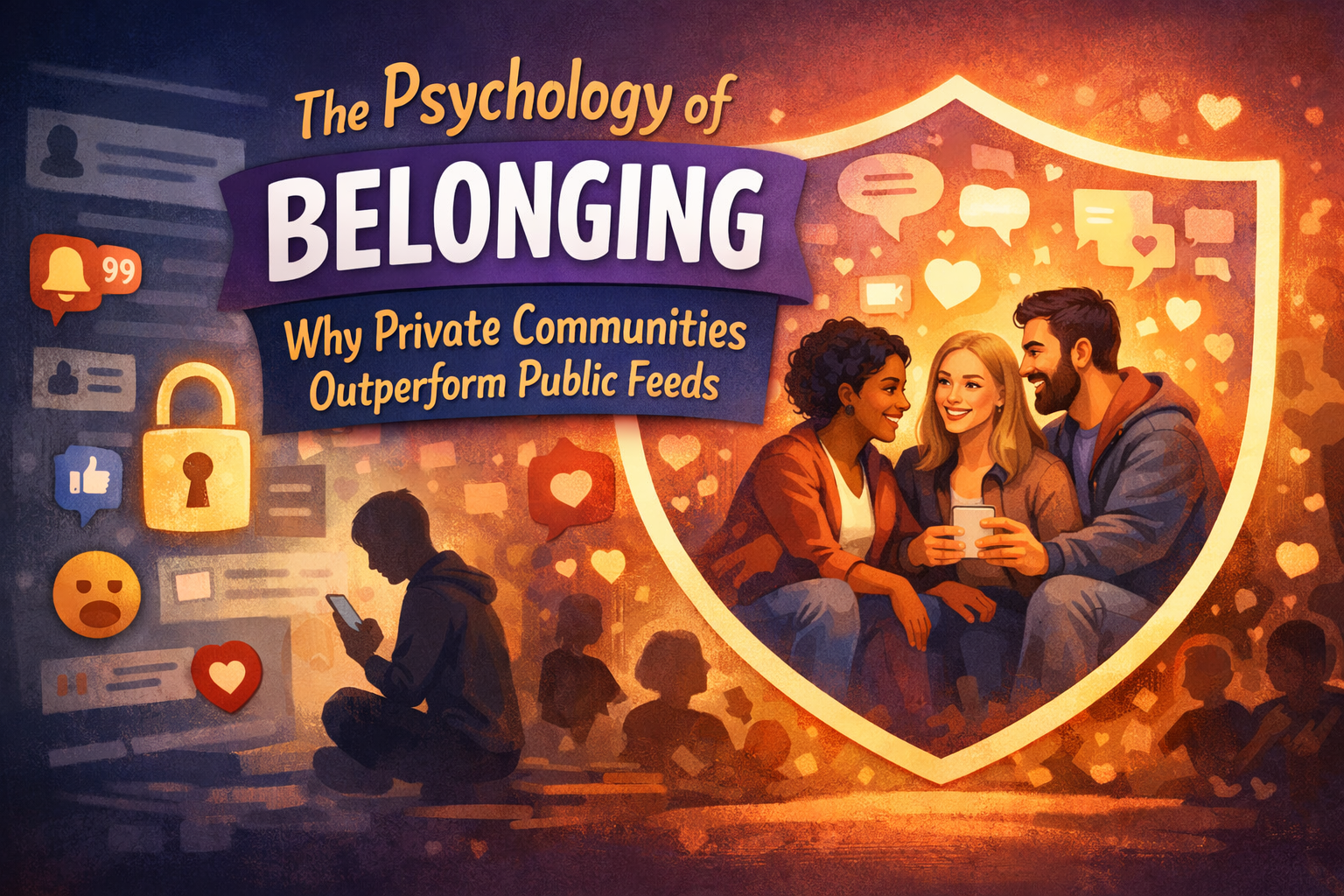
Public feeds are built for visibility.
Private communities are built for belonging.
As digital spaces become more crowded and algorithm-driven, engagement on public platforms often feels shallow. Meanwhile, private communities invite-only groups, member networks, gated platforms are seeing deeper conversations, higher retention, and stronger peer relationships.
Why?
The answer lies in community engagement psychology specifically, how humans experience belonging, safety, and identity in group environments.
Let’s break down the behavioral science behind why private communities outperform public feeds and what it means for community builders in 2026.
Psychologists have long identified belonging as a fundamental human motivation. People are wired to seek:
Shared identity
Recognition
Emotional safety
Mutual contribution
Public feeds prioritize broadcasting.
Private communities prioritize connection.
That structural difference changes how people behave.
In a public feed:
Audiences are undefined
Conversations are performative
Algorithms influence visibility
In private spaces:
Members know who they’re speaking to
Expectations are clearer
Norms are reinforced through interaction
Belonging thrives in environments with boundaries.
One of the strongest predictors of engagement is psychological safety the belief that you can speak without fear of embarrassment or attack.
Public feeds often lack this safety because:
Posts are visible to wide, mixed audiences
Comments are permanent and searchable
Social judgment is amplified
Private communities reduce these risks.
Members feel safer sharing:
Questions
Unfinished ideas
Challenges
Honest feedback
When psychological safety increases, participation increases.
This is a core reason searches for private communities and invite-only community platforms are rising.
Public feeds encourage identity signaling.
Users optimize posts for:
Likes
Shares
Professional branding
Algorithm reach
Private communities encourage genuine expression.
Because audiences are defined and smaller, members feel less pressure to perform and more freedom to contribute meaningfully.
Behavioral insight:
When impression management decreases, authentic engagement increases.
In large public feeds, interactions are dispersed.
You might engage with someone once and never see them again.
Private communities create social density:
Members encounter each other repeatedly
Conversations build over time
Shared references emerge
Repeated interaction strengthens:
Trust
Reciprocity
Emotional investment
Community engagement psychology shows that repeated exposure increases relational depth. This is why smaller, focused groups often outperform larger, open networks in engagement quality.
Another behavioral principle at play: scarcity.
Invite-only or gated communities signal:
Intentional membership
Higher signal-to-noise ratio
Exclusive value
Scarcity increases commitment.
Members who actively choose to join a private community are more likely to:
Participate
Stay longer
Contribute meaningfully
Public feeds require no commitment.
Private communities often require intent.
Intent drives engagement.
Public platforms are noisy environments.
Users scroll past:
Ads
Unrelated posts
Viral trends
Algorithmically inserted content
This creates cognitive fatigue.
Private communities reduce noise by:
Limiting irrelevant content
Centering around a shared theme
Structuring conversations intentionally
When cognitive load decreases, thoughtful participation increases.
This is why many brands shifting toward private community strategies are seeing stronger retention rates compared to relying solely on public channels.
Public feeds measure:
Impressions
Likes
Shares
Private communities measure:
Active participation
Discussion quality
Retention
Member-to-member interaction
From a data perspective, private communities often show:
Higher comment-to-post ratios
Longer conversation threads
More repeat contributors
The goal shifts from visibility to vitality.
Belonging doesn’t just increase engagement it drives measurable outcomes.
Private communities can improve:
Member retention
Customer lifetime value
Product adoption
Brand advocacy
When people feel seen and valued, they invest more deeply.
Community engagement psychology directly impacts revenue, loyalty, and long-term growth.
Public feeds attract attention.
Private communities build attachment.
Attachment drives business impact.
Yes, but their role is different.
Public platforms are powerful for:
Discovery
Thought leadership
Top-of-funnel visibility
Private communities are powerful for:
Relationship depth
Trust-building
Sustainable engagement
The strongest strategy in 2026 is ecosystem-based:
Public → Attraction
Private → Belonging
Community → Retention
If you’re investing in private community growth, focus on:
Clear identity and purpose
Defined membership boundaries
Consistent moderation and tone
Structured participation prompts
Rituals and recurring engagement moments
Belonging does not happen automatically.
It is designed.