
Traditional sales channels are bleeding efficiency, making a B2B dark social community the new core engine for growth. As top-of-funnel ad costs rise and buyers develop “content blindness” toward generic inbound whitepapers, purchasing power has migrated entirely into untracked, high-trust channels. Modern B2B decision-makers no longer fill out landing...
Read more
Most community managers manage toward vanity metrics like total member count or message volume. Meanwhile, B2B SaaS Customer Success (CS) teams treat churn as an operational science based on telemetry, health scores, and automated interventions. By adapting SaaS retention strategies into actionable community retention playbooks, you can convert passive,...
Read more

Quick Answer: Vanity metrics — follower count, impressions, page views measure reach, not relationship. To track real community engagement, use behavioral metrics instead: repeat attendance, RSVP-to-attendance rate, referral rate, and 90-day member retention. These event metrics predict outcomes; reach metrics only predict visibility. 10,000 followers mean very little if...
Read more
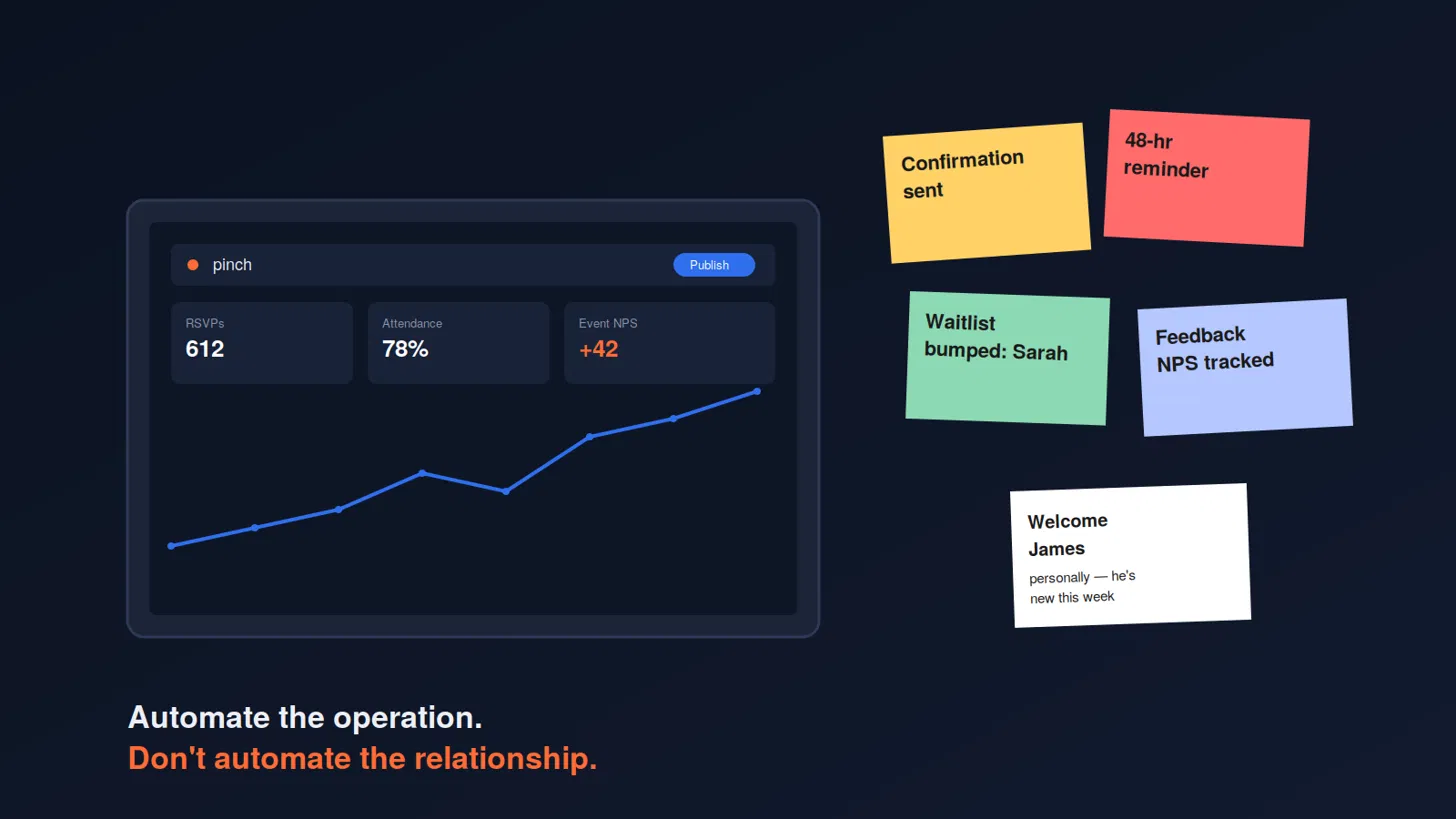
Here’s the rule before the reasoning: automate the operation, not the relationship. Everything in this piece is about figuring out where that line sits for your community and knowing how to check it whenever a new task or tool comes along. The distinction isn’t about how much you automate. It’s...
Read more
Most community events underperform. Not because the topic was wrong or the organiser did not care but because the event was planned around the organiser’s convenience rather than the member’s experience. The member forgot it was happening. The RSVP process was friction-heavy. Nobody followed up after. The feedback was...
Read more
What Is Community Management? Community management is the practice of building, nurturing, and sustaining an engaged group of people around a shared interest, identity, or goal. A community manager creates the conditions for members to connect with each other, participate in events and discussions, and find genuine value in...
Read more
Most communities fail before they reach 100 members. Not because the organiser lacked passion. Not because the topic was wrong. Not because the platform was bad. They fail because they were built for the organiser’s goals not the members’ needs. A member-first community flips that equation. Every structural decision ...
Read more
A member-first community is a group online, offline, or hybrid where every decision about membership, events, content, and engagement is made around the needs of members rather than the goals of the hosting organisation. It is the opposite of a broadcast community, where a brand pushes content at an...
Read more
Customer acquisition is getting harder for communities. Paid channels are saturated.Organic reach is declining.Trust in traditional marketing is weakening. For years, growth depended on one thing:spend more to acquire more. But that model is breaking. In 2026, a different approach is emerging one where growth is not just driven...
Read more
Customer acquisition costs are rising. Paid channels are getting expensive.Organic reach is declining.Competition is increasing. For many companies, scaling growth now means spending more to acquire the same customer. But there’s a shift happening. High-performing companies are using community as a growth system not just for engagement, but to reduce...
Read more