
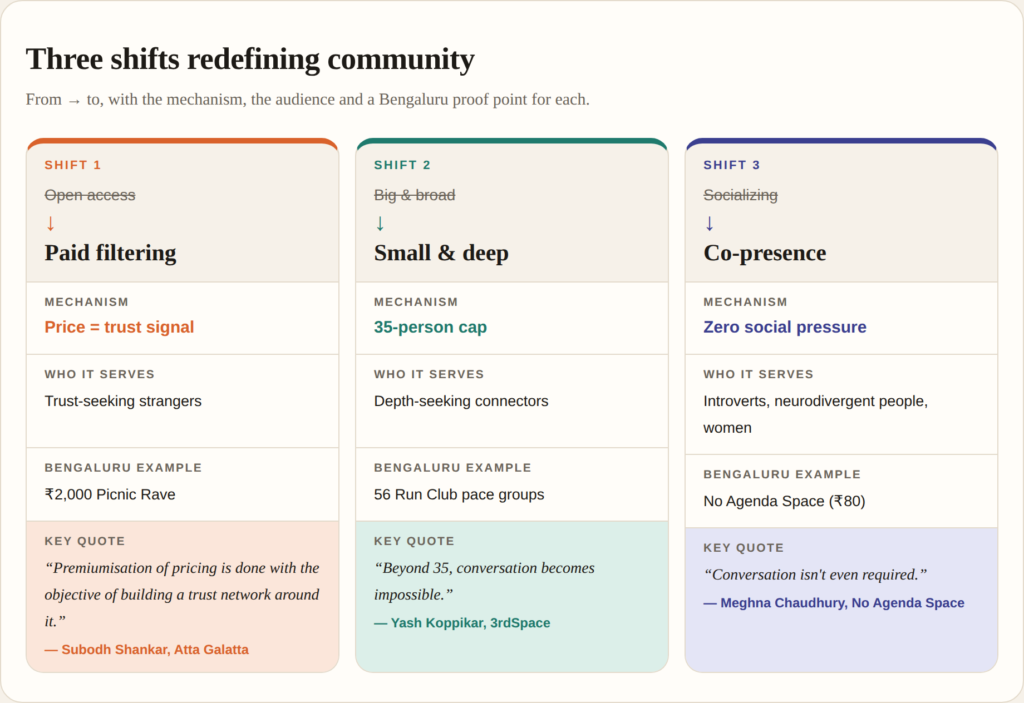
Bottom line up front: Bengaluru is experiencing a third-space explosion driven by a loneliness economy. This isn’t about more cafes opening it’s a fundamental shift in how communities are built. Three core insights matter for community builders: paid filtering is replacing open access as the default trust mechanism; micro-scale (under 35 people) is replacing large gatherings as the viable formula for depth; and “no agenda” is replacing “forced socializing” as the lowest-friction entry point for introverts and highly sensitive people.
Bengaluru’s third-space boom has an overlooked origin point: the structural manufacturing of loneliness.
Yash Koppikar, founder of 3rdSpace Indiranagar, describes a quintessential Bengaluru trajectory: locals who leave for abroad and return, only to find every friend has moved away. “At 26, you suddenly feel like you’re starting over with making friends.” Meanwhile, the massive influx of tech migrants has no traditional family or friend networks to plug into. The city is physically crowded but sociologically dispersed.
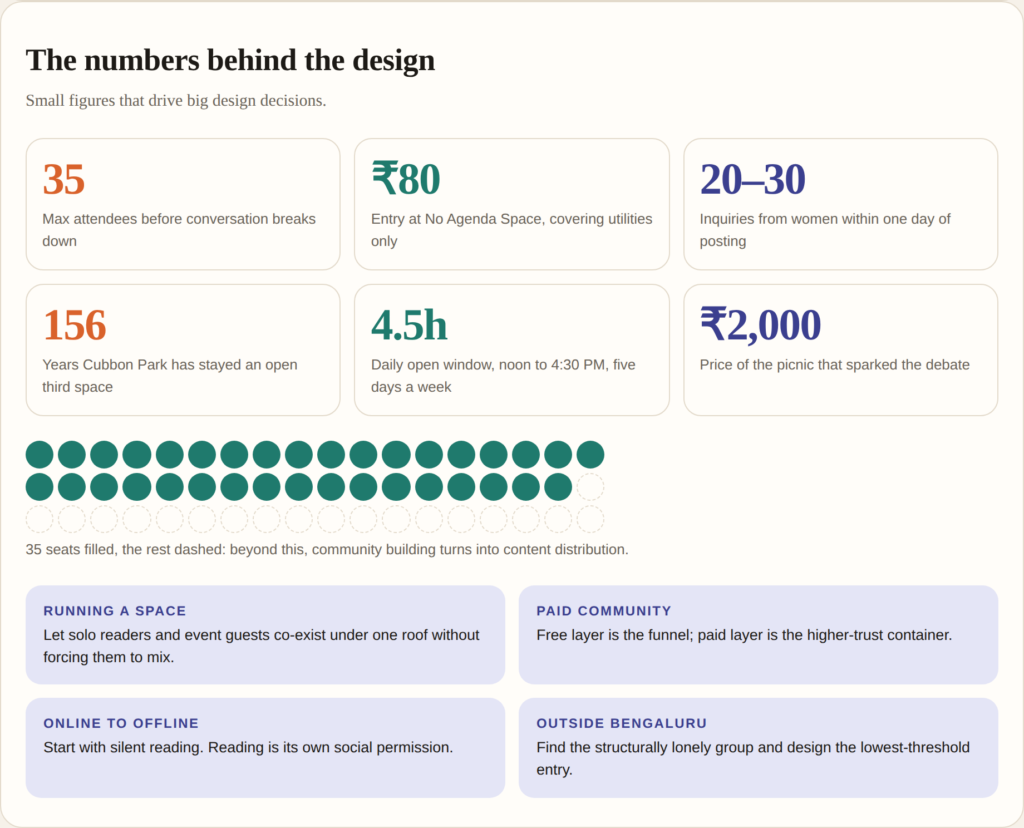
More hidden still is the specific spatial deprivation faced by women. Meghna Chaudhury opened her Indiranagar home as “No Agenda Space” for a simple reason: women are expected to perform in every space — perform friendliness, perform hospitality, perform emotional labor. Her space’s rule is anti-performance: “Conversation isn’t even required.” Within a single day of posting on social media, she received inquiries from 20–30 women.
Bengaluru also carries a unique inheritance: the memory of the katte. Traditionally, communities gathered naturally on stone platforms beneath banyan trees. “Our grandparents created community on kattes, just through simple, consistent presence,” says Deepali Dwarakanath of Third Space Collective. This cultural memory means Bengaluruites have a muscle memory for purposeless gathering. They don’t need to be taught what a third space is they just need to be given one again.
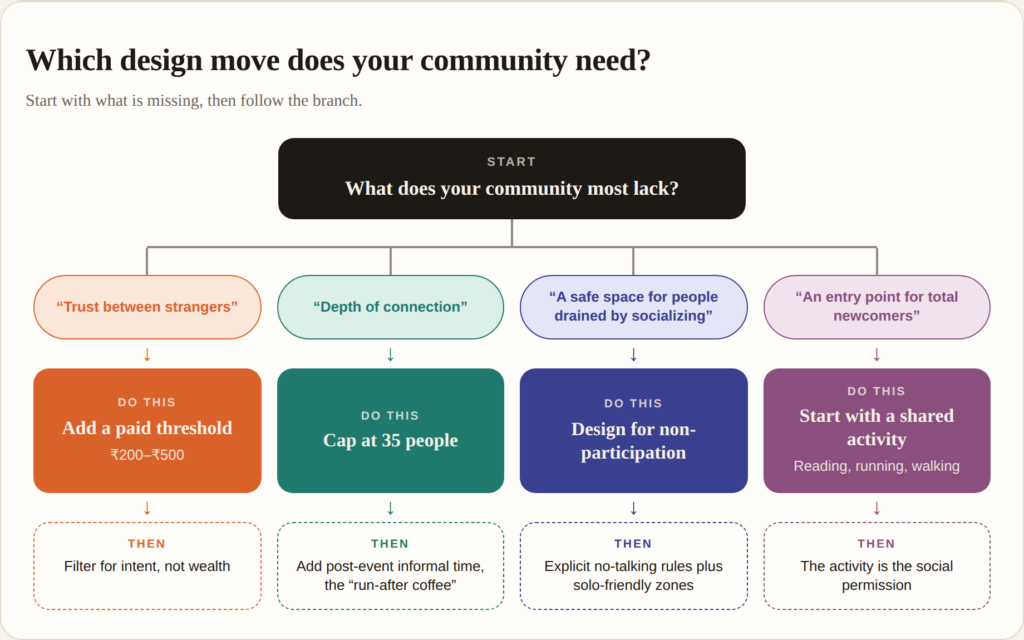
Actionable insight: If you’re building community in Bengaluru, don’t start with “events.” Start with “deprivation.” Ask your target group: what specific type of connection are they missing? Deep conversation? Non-sexualized cross-gender socializing? Solitary companionship that doesn’t require spending money? The answer determines your spatial form.
A Bengaluru Mirror investigation surfaced a sharp contradiction: a ₹2,000 “Picnic Rave” sparked controversy “Why pay to picnic when Cubbon Park is free?” But the deeper answer is: people are buying trust with price.
Subodh Shankar, co-founder of Atta Galatta, offers an observation worth chewing on: “Premiumisation of pricing is done with the objective of building a trust network around it.” In a city where trust between strangers is declining, price becomes a filtering mechanism it doesn’t guarantee you’ll meet “the right people,” but it lowers the probability of encountering “completely wrong ones.”
This explains a seemingly paradoxical phenomenon: Bengaluru simultaneously hosts two extreme ends of the third-space spectrum. At one end is Cubbon Park free, open, thresholdless for 156 years, where weekend Cubbon Reads gathers hundreds in silent reading. At the other end are ₹2,000 paid picnics and curated social events. Both are growing.
Which end you choose depends on your community’s goals. Free open spaces are suited to building “weak ties” and urban belonging; paid filtered spaces are suited to building “strong ties” and trust density. Confusing the two is one of the most common mistakes in community building.
Actionable insight: If you’re running a community that requires psychological safety (women’s spaces, vulnerable creator sharing, deep dialogue), a paid threshold isn’t greed it’s infrastructure. A price point of ₹200–₹500 is enough to filter out random intruders without excluding genuine need.
Yash Koppikar’s rule is simple: cap events at under 35 people. This isn’t a capacity constraint — it’s experience design. His judgment: beyond 35, conversation becomes impossible, especially for “people who aren’t comfortable speaking in large groups.”
Behind this number lies a logic repeatedly validated by Bengaluru’s community experiments: the value of a third space isn’t “meeting many people” it’s “the way you meet the right people.” Divya Shankar, a frequent participant in paid curated third spaces, explains why she prefers filtered events: “Knowing there will be like-minded people there removes the hesitation of a first-timer.”
The explosion of running clubs is the same logic in a different expression. Bengaluru’s running clubs have entered a “fourth generation” — evolving from 1960s elite running groups into organizations built around inclusivity and beginner-friendliness. The key design elements: multiple pace groups, walking options, icebreaker segments, and post-run coffee. Arvind Srikanth of 56 Run Club says that over the past two years, many friendships and business connections formed during these informal post-run gatherings.
Actionable insight: Upgrade your “event cap” from a convenience question to a design decision. If you want connection quality over participation numbers, 35 is a Bengaluru-validated threshold. Beyond it, your event shifts from “community building” to “content distribution.”
No Agenda Space sits at the most radical end of Bengaluru’s third-space spectrum. Meghna Chaudhury’s rule: no conversation required, no interaction required, no form of “participation” required.
This sounds anti-community, but it reveals a population overlooked by mainstream community-building discourse: those who are consumed by “socializing” itself. Neurodivergent people (ADHD, autism spectrum) must continuously manage their behavior in traditional social spaces. Rinkle Jain, a neurodiversity psychologist in Mumbai, explains what third spaces mean for this group: “They can’t pace around freely at work, and they can’t expect a quiet environment at home. Third spaces give them agency. They can almost breathe better.”
Chaudhury’s space is open noon to 4:30 PM, five days a week, requires advance online registration, and charges ₹80 to cover utilities. People come to sleep, draw, read, use WiFi, and be with the dog. One woman’s therapist recommended she come here for online therapy — because she had no safe private space at home to do it.
Actionable insight: If your community only serves extroverts and the socially skilled, you’re missing a large and highly loyal demographic. “No agenda” isn’t “no design” it’s a different design: lowering the participation threshold to zero social pressure. This means your space must permit “non-participation,” have explicit rules protecting solo users, and cultivate a culture of shared presence that doesn’t require speaking.
If you’re outside Bengaluru:
Bengaluru’s model is spreading. No Agenda Space received inquiries from other cities almost immediately after opening. The transferable principle isn’t “open your home” it’s identify your city’s structurally lonely population and design the lowest-threshold entry point. Every city has its own katte equivalent maybe a temple courtyard, a park corner, a reading area in a community library.
If you’re running a space:
Consider “diversity spectrum” design. Yash Koppikar’s 3rdSpace serves two types simultaneously: people who come alone to read in the library area, and people who come to events to socialize. When events run, the library closes, but the library crowd stays to “unwind.” The key to this hybrid model: don’t force the two groups to interact, but let them co-exist under one roof.
If you’re building a paid community:
Study Atta Galatta’s model. It runs free events (like film screenings) alongside paid events (₹200–₹300 ticketed screenings), plus the bookstore’s free browsing space. Price tiers don’t correspond to “value tiers” they correspond to “participation depth tiers.” The free layer is the entry point and funnel; the paid layer is the higher-trust-density container.
If you’re converting online to offline:
Cubbon Reads may be the simplest starting point. Every Saturday morning, hundreds gather in Cubbon Park with books and picnic mats, then read silently for one to two hours. No agenda, no facilitation, no icebreakers. This model has already been replicated in multiple cities globally. Its scalability comes from one fact: reading itself is social permission you don’t need to explain why you’re there.
Bengaluru’s third-space boom has an easily romanticized fact: it is also a symptom of shrinking public space. Reporting by Bengaluru Mirror notes that restrictions on public spaces, maintenance issues, safety concerns, and tightening regulation are pushing people toward paid, private alternatives. One filmmaker, Niki Kalpa, offers a comment worth taking seriously: “True third spaces are slowly disappearing in most hyper-urbanized areas.”
This means: a third-space boom isn’t always a healthy signal. When people are willing to pay ₹2,000 for a picnic, part of the reason is that there aren’t enough safe, clean, free spaces beyond Cubbon Park. Your community-building work, at the micro level, connects people. At the macro level, it responds to the contraction of public life.
The most sustainable third-space strategy may be dual-track: on one hand, build paid, high-trust-density containers; on the other, use whatever resources you can mobilize to protect and support free public spaces. Cubbon Park became the “ultimate third space” over 156 years not because someone designed it, but because generations of Bengaluruites defended it.
The best community building, in the end, is about making “being together” something that doesn’t require a reason.