
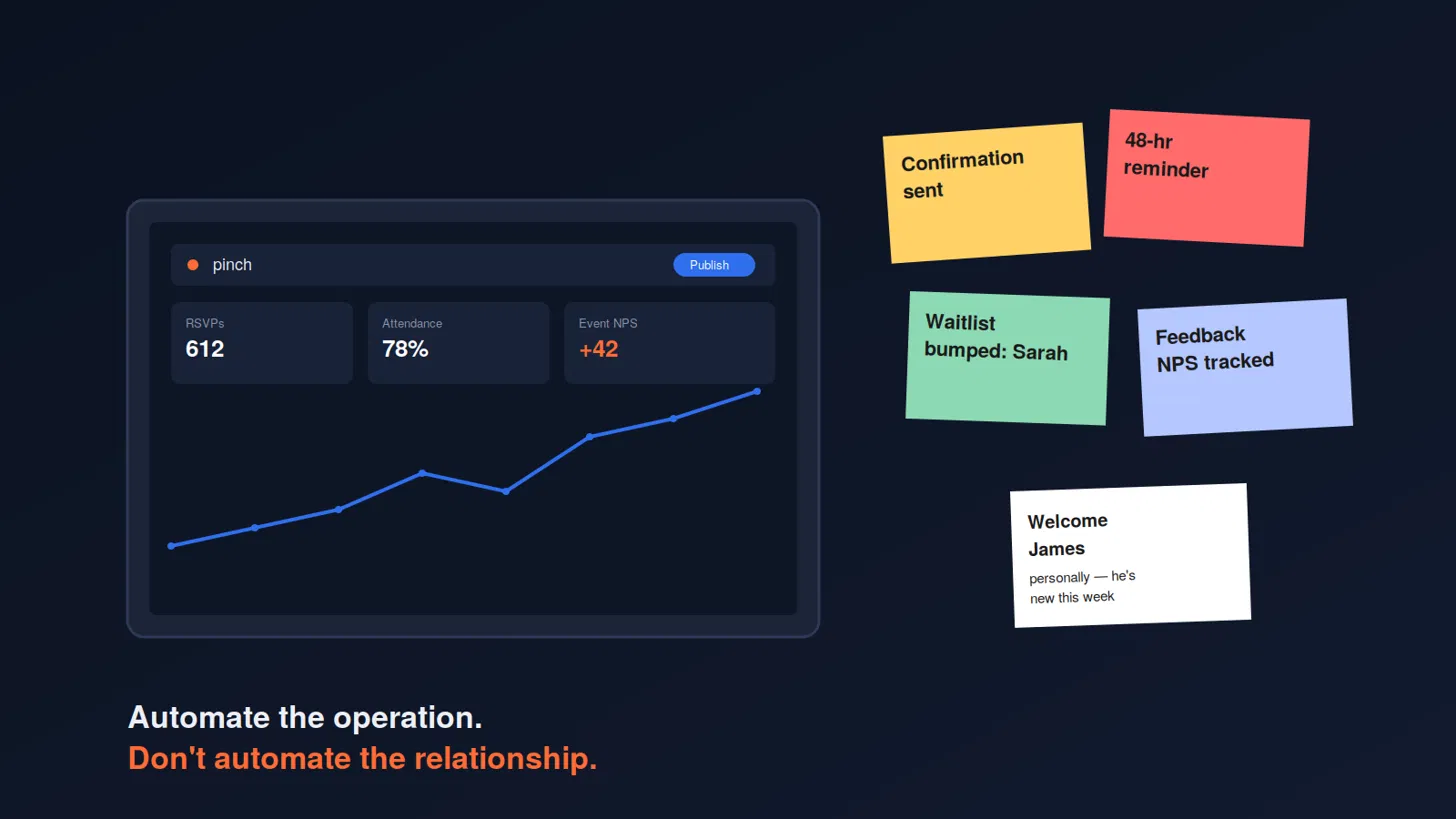
Here’s the rule before the reasoning: automate the operation, not the relationship.
Everything in this piece is about figuring out where that line sits for your community and knowing how to check it whenever a new task or tool comes along.
The distinction isn’t about how much you automate. It’s about what you automate. Some tasks are about state and sequence: they need to happen the same way, every time, without someone having to remember or manage them manually. Others require judgment about a specific person in a specific moment. Confusing the two is where most “AI runs your community” tools go wrong and where organizers end up spending time on the wrong layer of the work.
When this matters
This framework is useful when you’re evaluating a new tool, when event logistics are running smoothly but turnout has quietly flattened, when someone suggests automating a welcome message, or when you realize you’re spending more time managing RSVPs than talking to the people who actually showed up.
It matters even more as your community grows beyond what one person can keep in their head. That’s when teams tend to make one of two mistakes: over-automating relationships into templates, or under-automating operations that a system should simply handle.
What Matters Most
Operational vs. relational — the real split
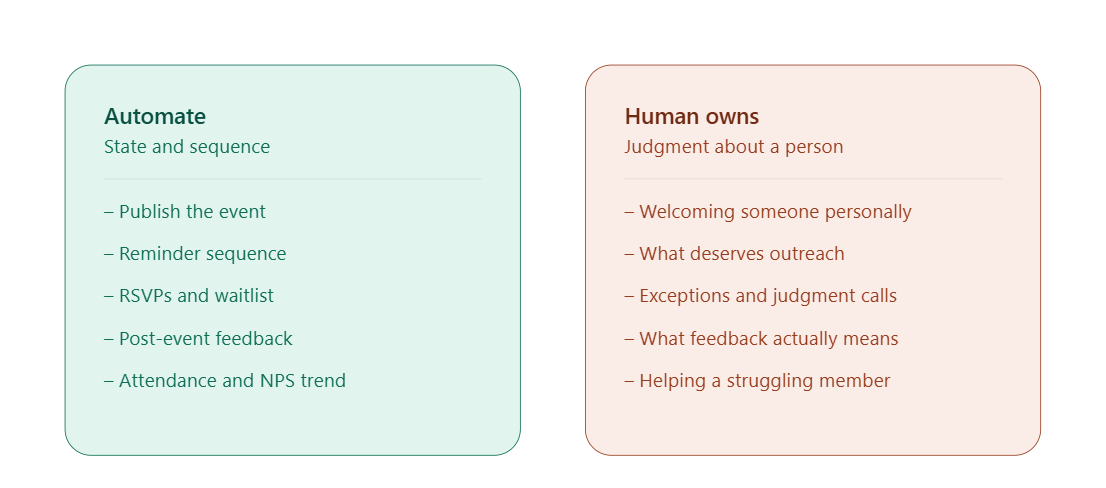
Operational tasks are about process: publishing events, sending reminders, tracking RSVPs, collecting feedback, and aggregating attendance. They follow a predictable sequence and don’t require much judgment. They just need to happen reliably, every time.
Relational tasks are about people: welcoming someone personally, knowing who needs a follow-up, noticing when a member goes quiet, or responding when someone is struggling. They require context and judgment things that can’t be captured in a fixed sequence.
A rule of thumb, not a spectrum
This isn’t about choosing how much to automate. It’s a simple check:
Does the task need a state tracked and a sequence run, or does it need someone to notice and decide?
If it’s the first, automate it completely. There’s no upside to having a person do it manually.
If it’s the second, leave it to a person. No amount of automation should replace the judgment involved.
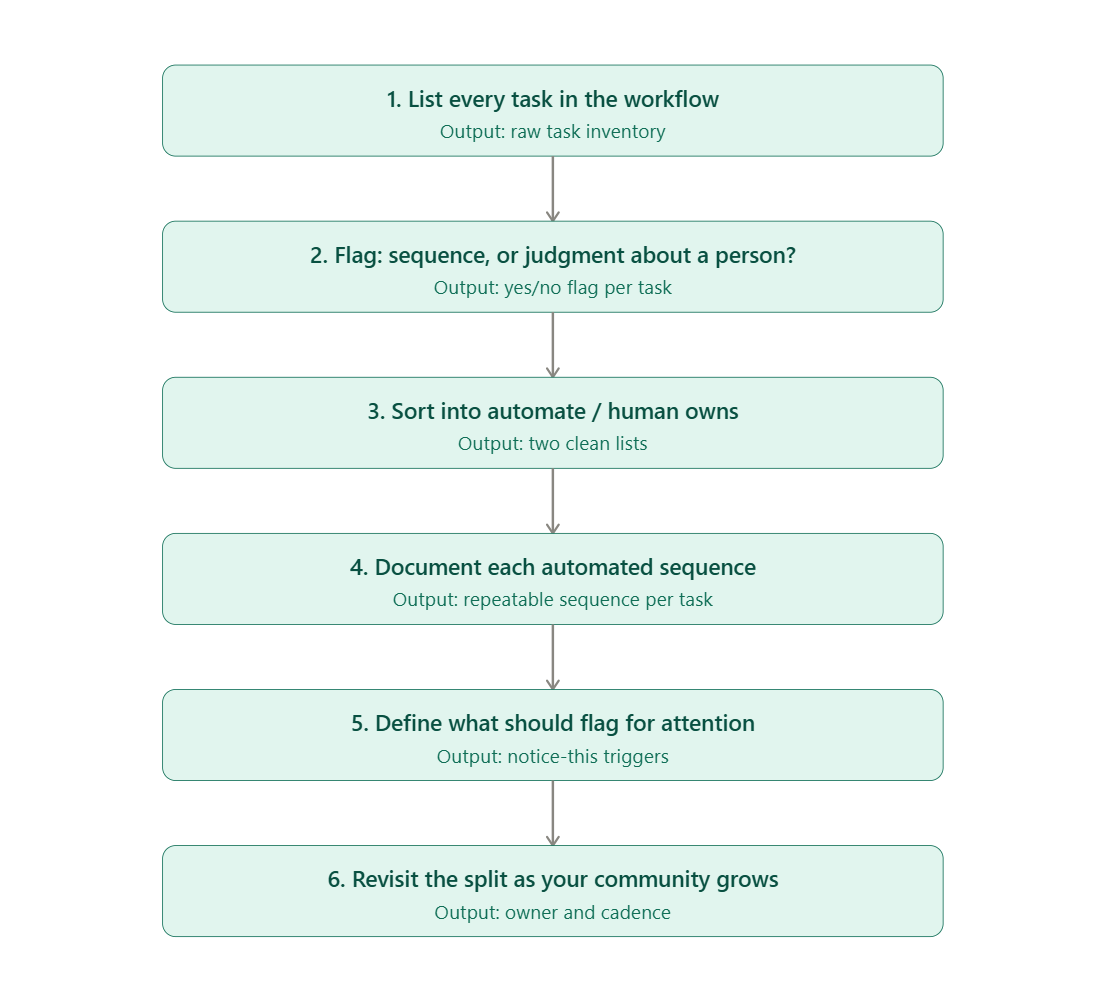
Putting it into practice
Where people get stuck
Automating too far up the stack. Treating a welcome message or a check-in with a struggling member as sequenceable. The moment a “personal” message is obviously generated, it stops doing the one thing it was for.
Not automating enough. Still manually tracking RSVPs, reminders, or feedback because the operational layer never got properly set up which leaves no time or attention left for the relational work that actually needed a person.
Confusing “no errors” with “working.” The operational layer can run perfectly every reminder sent, every RSVP tracked while the relational layer quietly breaks. A clean dashboard doesn’t mean the community is being tended.
Before you move on
What good looks like
|
Task |
Automate? | Human owns |
| Create and publish the event | Yes |
What the event actually is |
|
Send confirmation and reminder sequence |
Yes |
What deserves personal outreach |
|
Track RSVPs and waitlist |
Yes | Exceptions and judgment calls |
|
Send post-event feedback |
Yes | What the feedback actually means |
| Aggregate attendance and NPS over time | Yes |
What to change next time |
| Welcome someone personally | No |
The relationship |
| Decide how to handle a struggling member | No |
The relationship |
How to know it’s working
Operational metrics—reminders sent on time, RSVPs tracked accurately, feedback collected without manual work tell you the system is running.
Relational signals—a returning attendee, a member who received a thoughtful response instead of an automated update, someone who went quiet and was actually checked on tell you the community is being cared for.
You need both. If the operational layer is running perfectly but the relational signals are disappearing, the automation has probably crossed the line.
Key takeaways
Common questions
Isn’t automating the welcome message just saving time? It saves time on the wrong task. A welcome message is the first relational signal a new member gets automating it removes the one thing that told them a person was actually there.
How do we know if something’s relational vs. operational? Ask whether the task needs to happen the same way for everyone, or whether the right action depends on who the specific person is. If it depends on the person, it’s relational.
What if we don’t have bandwidth to do the human part well yet? Automate the operational layer completely first — that’s usually where the missing hours are. Most teams find the bandwidth for the relational work once they’re not manually tracking RSVPs and reminders.
When should we revisit what’s automated? Whenever your community’s size or stage changes meaningfully, and on a regular cadence beyond that a task that needed a person early on can become sequenceable later, and vice versa.