
Customer acquisition costs are rising.
Paid channels are getting expensive.
Organic reach is declining.
Competition is increasing.
For many companies, scaling growth now means spending more to acquire the same customer.
But there’s a shift happening.
High-performing companies are using community as a growth system not just for engagement, but to reduce Customer Acquisition Cost (CAC).
This isn’t about replacing marketing.
It’s about building a system where customers help drive growth.
Customer Acquisition Cost (CAC) is the total cost of acquiring a new customer, including:
When CAC increases faster than revenue, growth becomes inefficient.
Reducing CAC is not just about cutting spend.
It’s about improving how customers are acquired.
Most companies rely heavily on:
These channels:
As a result, CAC continues to rise.
This is where community changes the model.
Communities don’t just engage users.
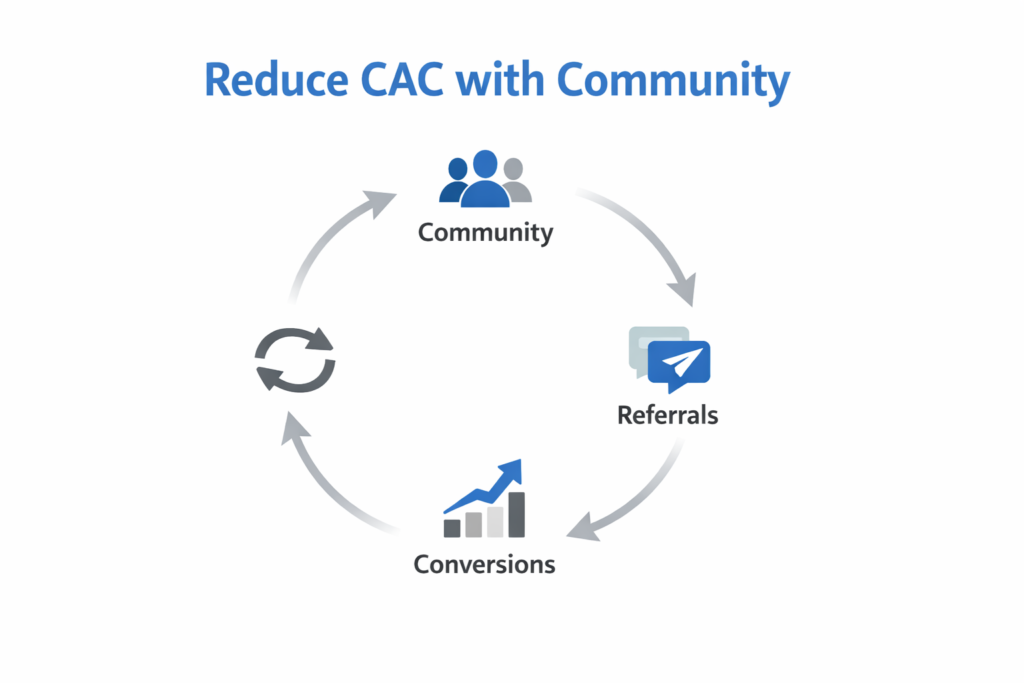
They create organic acquisition loops.
Here’s how.
In traditional models:
Companies acquire customers.
In community-led models:
Customers help acquire customers.
When members:
They generate high-trust referrals.
Referral-based acquisition:
This directly reduces CAC.
Word-of-mouth has always been powerful.
Communities make it repeatable and visible.
Instead of isolated conversations, communities:
This allows word-of-mouth to compound.
Organic conversations become a distribution channel.
Trust is one of the biggest factors in conversion.
Communities help prospects:
This reduces:
By the time a user becomes a customer, they are already informed and confident.
Lower friction = lower CAC.
Content marketing is expensive to scale.
Communities generate content naturally:
This user-generated content:
Instead of producing all content internally, companies benefit from continuous, relevant content creation.
Reducing CAC isn’t just about reducing spend.
It’s also about increasing conversion efficiency.
Communities help by:
When prospects see others succeeding, they are more likely to convert.
Higher conversion rates = lower CAC.
As community-driven acquisition grows, reliance on paid channels decreases.
Companies can:
Community becomes a compounding acquisition layer, unlike paid channels that reset every month.
CAC is closely tied to retention.
If customers leave quickly:
Communities improve retention through:
Higher retention improves:
Even if acquisition cost stays the same, better retention improves overall economics.
To connect community to CAC, track:
These metrics show how community reduces acquisition dependency.
Community is not just for promotion.
It’s a system for trust and participation.
Community-driven CAC reduction is long-term and compounding.
If members aren’t encouraged to share or invite, growth slows.
User-generated discussions are a powerful SEO asset.
They:
Community becomes part of the growth strategy not an experiment.
Paid channels drive immediate results.
Community builds long-term efficiency.
The goal is not to eliminate paid acquisition.
It’s to build a system where:
This is how CAC decreases sustainably.
Community reduces CAC by changing how growth works.
Instead of relying entirely on paid acquisition, it creates:
The result is not just lower CAC
but a more resilient and scalable growth model.